
Araujia odorata
Araujia odorata
Description
How to tell it apart
Araujia odorata is a perennial climbing vine belonging to the Apocynaceae family. Known for its rapid growth, this species utilizes nearby vegetation or structural supports to reach significant heights, often choking out other plants in its path.
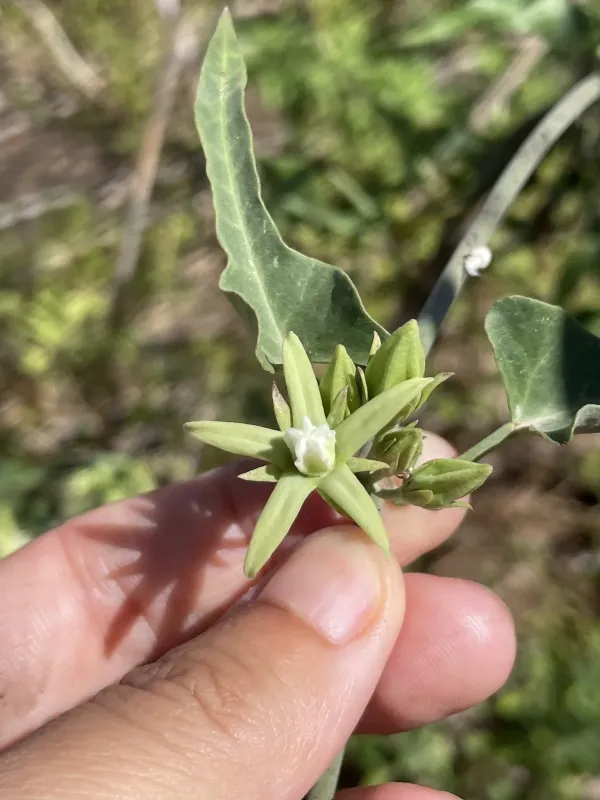
The plant features opposite, lanceolate leaves and aromatic, trumpet-shaped flowers. The flower color usually ranges from white to creamy, which aids in attracting pollinators, thereby ensuring successful seed production throughout the growing season.
The fruit of Araujia odorata is a large, woody follicle that splits upon maturity. It contains numerous seeds equipped with silky tufts, allowing for efficient long-distance dispersal via wind currents across agricultural landscapes.
A distinctive botanical feature is the presence of a milky white latex throughout the plant tissues. This sap is known to be irritating to human skin and can be toxic if ingested, making manual handling of the vine a difficult and unpleasant task.
The root system is robust and highly regenerative. Even if the aerial parts are severed, the plant can often sprout again from the remaining underground rhizomes, making complete eradication a prolonged and labor-intensive process.
Where it grows
This weed thrives in warm climates and is frequently found in agricultural settings, hedgerows, and along road verges. It is highly adaptable to various soil types, provided there is adequate moisture for establishment.
In farming operations, it primarily targets perennial crops such as orchards and vineyards. The vine uses fruit trees and grapevines as support structures, effectively climbing to the canopy to compete for sunlight.
The wind-dispersed nature of its seeds allows Araujia odorata to colonize new territories rapidly. It is common to find dense patches of this weed along irrigation canals and near disturbed soil where competition from native species is lower.
The species excels in occupying niches within human-modified ecosystems. Its ability to grow in both full sun and partial shade gives it a competitive edge over many other plant species in a variety of environmental conditions.
While some related species are valued as ornamentals, Araujia odorata is widely classified as a problematic weed due to its aggressive expansion patterns and the lack of natural predators in many regions.
Harm it causes
The primary damage caused by Araujia odorata is the mechanical suppression of crops. By twining around the stems and branches of host plants, the vine limits light penetration, which inhibits photosynthesis and significantly reduces overall yield.
In orchards and vineyards, the weight of the vine can become excessive, leading to branch breakage or the collapse of trellising systems during stormy weather. This causes both immediate physical damage and long-term economic losses.
As a resource competitor, the vine draws significant amounts of water and soil nutrients away from the crops. In arid regions or during drought, this competition can be the deciding factor in crop failure for young or weak plants.
The latex contained in the plant tissues renders the weed unpalatable and potentially toxic to livestock. Accidental consumption by cattle or sheep can lead to digestive distress and poisoning, posing a significant risk to farmers.
High seed production rates make the weed a persistent threat to field hygiene. Once established, it can easily infest an entire farm, necessitating intensive and costly management practices to maintain production standards.
How to control
Mechanical control measures include deep plowing and regular cultivation to extract and destroy the rhizomes. Repeated efforts are required during the pre-flowering stage to prevent the plant from replenishing its energy stores and producing seeds.
Manual removal of young seedlings is effective if done before the root system becomes deep and complex. The use of dark mulch or ground cover can help limit the light availability for emerging sprouts, suppressing early development.
Chemical control involving systemic herbicides is often necessary for mature, established populations. Targeted application on cut stems or foliar spraying during the active growth phase provides the most consistent results for eradicating the vine.
Good agricultural practices, including crop rotation and maintaining high-density plantings, can help shade out the weed. By limiting the space available for new colonization, farmers can reduce the risk of successful Araujia establishment.
Monitoring field boundaries and water sources for early signs of infestation is crucial. Quick intervention at the first sign of the weed helps prevent wide-scale dispersal, protecting the integrity of the entire crop area.
Taxonomy
- Latin name
- Araujia odorata
- Family
- Кутровые
- EPPO code
- MONOD