
Suaeda vera
Suaeda vera
Description
How to tell it apart
Suaeda vera, commonly known as shrubby seablite, is a perennial subshrub belonging to the Amaranthaceae family, well-adapted to high-salinity environments.
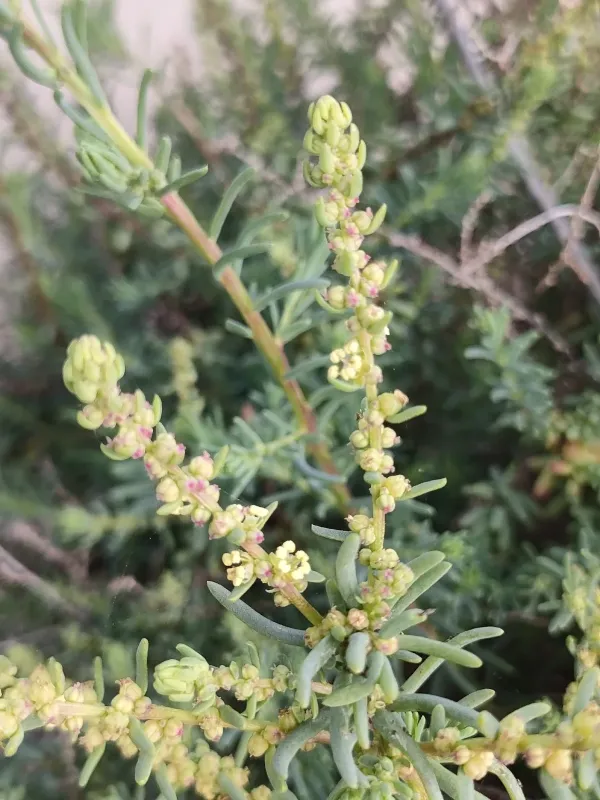
The plant typically grows up to one meter in height, featuring woody stems at the base and numerous branches covered in fleshy, linear leaves with a glaucous appearance.
Its leaves are specifically adapted to accumulate salt, allowing the plant to thrive in conditions where most other vegetation would suffer from osmotic stress.
The flowers are small and inconspicuous, appearing in clusters within the leaf axils, typically blooming from mid-summer through early autumn.
The seeds are small, rounded, and highly resilient, maintaining viability in the soil seed bank for extended periods, which facilitates rapid re-colonization.
Where it grows
This species is native to saline habitats, including coastal marshes, salt flats, and arid regions where the soil salinity levels are significantly elevated.
In agricultural settings, Suaeda vera colonizes irrigated fields that suffer from secondary salinization, often found near drainage canals or poorly managed land.
It prefers areas with high evaporation rates and poor drainage, where salts tend to accumulate on the soil surface, creating an ideal niche for this halophytic plant.
The weed often encroaches on field margins and uncultivated paths, utilizing these areas as reservoirs to spread seeds into primary production zones.
Its ability to tolerate periodic waterlogging makes it a persistent nuisance in low-lying fields that face challenges with moisture and salt management.
Harm it causes
Suaeda vera competes directly with crops for nutrients and sunlight, often gaining a competitive advantage in fields where salinity hinders crop development.
By accumulating salts, the weed can negatively impact the local rhizosphere, potentially altering the chemical environment for sensitive crop roots nearby.
High infestation levels lead to significant yield losses and reduced crop quality, as the weed depletes the soil of moisture and essential nutrients.
The presence of this woody weed complicates mechanical harvesting, causes equipment wear, and leads to the contamination of harvested grain lots.
Furthermore, it serves as a host for various pathogens and pests, potentially increasing the disease pressure on adjacent crops within the farm ecosystem.
How to control
Effective management requires addressing the root cause, which is soil salinity, through improved drainage, leaching of salts, and careful irrigation management.
Mechanical control through deep tillage can disrupt root systems, although repeated efforts are necessary due to the plant's robust nature and woody stem.
Chemical control involving systemic herbicides like glyphosate may be applied; however, results depend on the plant's growth stage and environmental conditions.
Prevention is crucial, involving the removal of the weed from field borders and irrigation infrastructure to eliminate local seed sources before they ripen.
- Soil leaching and drainage improvements.
- Systemic herbicide application during active growth.
- Deep plowing to eliminate established clumps.
- Regular monitoring of soil salt levels.
- Cleaning irrigation ditches and field margins.
Taxonomy
- Latin name
- Suaeda vera
- Family
- Амарантовые
- EPPO code
- SUEFR