
Suaeda occidentalis
Suaeda occidentalis
Description
How to tell it apart
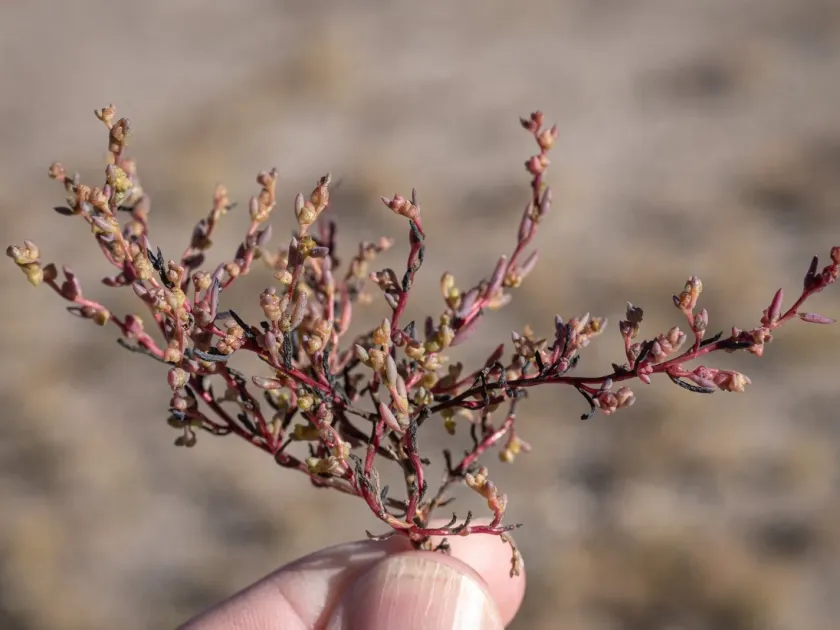
Suaeda occidentalis is an annual herbaceous plant belonging to the Amaranthaceae family. It is well-known for its ability to thrive in saline environments, displaying distinct morphological adaptations to high salt concentrations in the soil.
The plant features a branched stem that can grow up to 50 cm in height. Its leaves are succulent, narrow, and cylindrical, often showing a reddish or brownish tint as the plant matures, which is a common trait among many species of the genus Suaeda.
The flowers are small, inconspicuous, and lack petals, as they are primarily wind-pollinated. They are typically clustered in the leaf axils, contributing to the plant's unassuming appearance compared to broad-leaved weeds.
The root system is robust, designed to penetrate deep into the soil profile to access water. This adaptation allows the plant to survive in arid conditions where surface moisture is scarce or highly saline.
Suaeda occidentalis produces numerous small, dark seeds that exhibit high viability. This seed bank capacity ensures the plant's persistence in its habitat, often making it difficult to eradicate completely from a field.
Where it grows
Suaeda occidentalis is an obligate halophyte, meaning it is specifically adapted to growing in saline soils, including salt marshes, alkaline flats, and salt-affected agricultural lands.
In agricultural settings, this weed is commonly found in areas where secondary salinization has occurred due to poor drainage, intensive irrigation with mineralized water, or high groundwater levels.
It prefers disturbed, high-salinity areas where competition from less salt-tolerant plant species is minimal. As a result, it often colonizes marginal lands or poorly reclaimed fields, signaling underlying soil issues.
The distribution of this plant is typically restricted to arid and semi-arid zones. In these regions, high evaporation rates cause salts to accumulate in the upper soil horizon, creating ideal conditions for Suaeda.
Farmers often encounter this weed in fields that have been reclaimed or where soil management practices have failed to address salinity levels, leading to patches of persistent weed growth.
Harm it causes
The primary damage caused by Suaeda occidentalis is its intense competition with crop plants for water. Because it is highly adapted to saline stress, it often outcompetes cultivated crops in areas where soil conditions are unfavorable.
The presence of this weed creates dense stands that can shade out young crop seedlings, reducing their growth rates and overall biomass. This leads to yield losses, particularly in fields with irregular germination.
Furthermore, Suaeda occidentalis can serve as a host for various agricultural pests and pathogens. By acting as a reservoir, it facilitates the spread of diseases to neighboring crops, increasing the risk to the entire field.
The weed's presence is also a nuisance for harvesting operations. Dense growth patterns can interfere with machinery, potentially leading to equipment damage and increasing the cost of manual labor for field maintenance.
Consistent infestation leads to the accumulation of seeds in the soil, which complicates long-term field management and necessitates ongoing control efforts to prevent the spread of the weed in future seasons.
How to control
Effective management begins with addressing the root cause: soil salinity. Gypsum applications can help displace sodium ions, improving soil structure and creating a less favorable environment for halophytic weeds.
Improving the drainage system is essential for leaching excess salts from the topsoil. Regular flushing of the soil with fresh water can significantly reduce the viability of Suaeda populations in the long term.
Mechanical control methods, such as deep tillage and inter-row cultivation, are effective at destroying young plants before they reach the reproductive stage. Timing these operations correctly is critical for success.
Chemical control involves the use of selective herbicides, although options are limited by the crop type and the weed's specific physiology. Application should target the early growth phases to ensure maximum efficacy.
- Implement proper soil drainage and salt-leaching programs.
- Use pre-emergent herbicides to stop initial germination.
- Apply post-emergent systemic herbicides tailored to the specific crop.
- Practice crop rotation with salt-tolerant cultivars to minimize bare soil.
Taxonomy
- Latin name
- Suaeda occidentalis
- Family
- Амарантовые
- EPPO code
- SUEOC