
Tumbleweed
Salsola tragus
Description
How to tell it apart
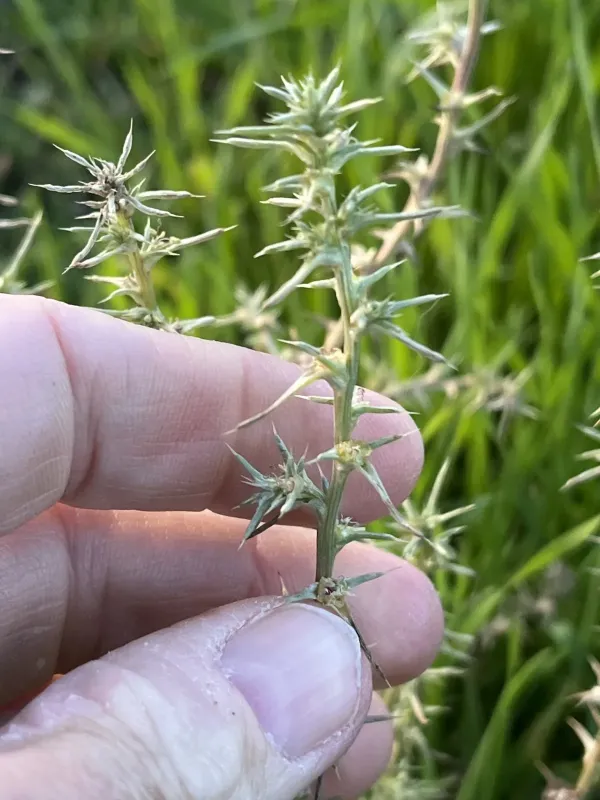
Salsola tragus, commonly known as Russian thistle or tumbleweed, is an annual herb belonging to the Amaranthaceae family, known for its distinctive rounded growth habit.
The plant features narrow, spine-tipped leaves that become rigid and prickly as the plant matures, serving as a primary defense against herbivores.
In its mature state, the stem structure becomes brittle at the base, allowing the entire plant to break off and roll with the wind, effectively dispersing thousands of seeds.
The flowers are small, solitary, and enclosed by papery bracts, which harden significantly as the seeds develop, adding to the plant's coarse texture.
Root development is characterized by a deep taproot, which is essential for extracting moisture in the semi-arid environments where this weed thrives.
Where it grows
This weed is native to dry, disturbed environments and is highly adaptable to various soil types, including sandy, gravelly, and alkaline soils.
Tumbleweed is a frequent invader of agricultural lands, particularly in regions where drought conditions or poor soil management prevail.
It occupies fallow fields, roadsides, fencerows, and overgrazed pastures, from which it spreads into productive crop fields via its rolling seed dispersal mechanism.
It is particularly problematic in cereal crops and row crops where moisture competition is a critical factor affecting yield stability.
The species excels in high-heat environments and is often one of the last remaining green plants in degraded landscapes due to its water-efficient physiology.
Harm it causes
Tumbleweed causes significant economic loss by outcompeting crops for essential resources such as nitrogen, phosphorus, and moisture, especially during dry spells.
Its deep taproot system allows it to access subsoil water, effectively depriving shallow-rooted crops and reducing overall biomass production.
During harvest, the dry and woody stems of the Russian thistle clog combine harvester headers and threshing cylinders, leading to significant downtime and mechanical wear.
The plant acts as a host for various agricultural pests, including beet leafhoppers, which can transmit serious viruses to vegetable and grain crops.
Furthermore, the presence of these weeds complicates grain cleaning processes, increasing the amount of foreign material that must be removed before marketing.
How to control
Integrated weed management for Salsola tragus requires a multi-faceted approach involving cultural practices and timely chemical interventions.
Preventative measures include maintaining vigorous crop stands that shade the soil, thereby reducing the light availability required for tumbleweed seed germination.
Cultivation should be performed while the plants are in the seedling stage, as they become much harder to control once the taproot is fully established.
Chemical control is most effective when herbicides are applied to young, succulent plants before they develop significant spine development or woody stems.
- Application of pre-emergence herbicides to prevent germination.
- Use of post-emergence selective herbicides during the early rosette stage.
- Monitoring fence lines and field edges to prevent the rolling plants from entering the field.
Taxonomy
- Latin name
- Salsola tragus
- Family
- Амарантовые
- EPPO code
- SASKT