
Red goosefoot
Oxybasis rubra
Description
How to tell it apart
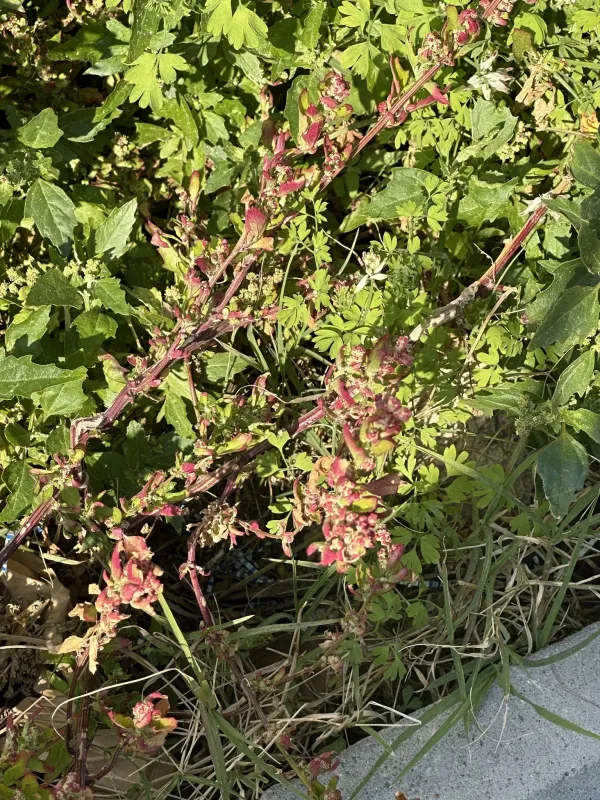
Red goosefoot (Oxybasis rubra) is an annual herbaceous weed belonging to the Amaranthaceae family. It is characterized by its erect or spreading stems, which often exhibit a distinct reddish tint during the growth cycle.
The leaves of this plant are typically diamond-shaped or triangular with irregularly toothed margins. The undersides of the leaves are often covered with a mealy, powdery substance, which is a common trait for species in this genus.
Flowers are very small and arranged in dense, cluster-like spikes in the leaf axils. As the plant matures, these inflorescences can turn into a dark reddish or brownish color, making the weed easily identifiable in the field.
The root system is a well-developed taproot that allows the plant to extract water and nutrients effectively from deeper soil layers, contributing to its resilience in various conditions.
Propagation occurs solely through seeds. A single healthy plant is capable of producing thousands of tiny, dark-colored seeds that can persist in the soil seed bank for many years.
Where it grows
Red goosefoot is widely distributed in temperate regions. It thrives in nitrogen-rich, moist, and loose soils, commonly found in riverbanks, floodplains, and damp agricultural areas.
In farming, it frequently infests row crops such as sugar beets, maize, potatoes, and sunflowers, where the open spaces between crop rows allow it to establish and spread rapidly.
The weed is also found in disturbed sites, including waste areas, roadsides, and livestock holding areas where soil fertility is high due to accumulated organic matter.
It prefers areas with poor drainage or high moisture levels, which can put cultural crops at a disadvantage and allow red goosefoot to become a dominant species in the field.
Its ability to adapt to different soil types and moisture regimes makes it a persistent nuisance in intensive farming systems across different continents.
Harm it causes
The primary damage caused by red goosefoot is competition with crops for essential resources: sunlight, water, and soil nutrients, particularly nitrogen.
Because of its rapid early-season growth, red goosefoot can quickly overtop crop seedlings, causing severe shading and reducing the overall vigor and yield potential of the crop.
Red goosefoot serves as an alternative host for various agricultural pests and pathogens, increasing the risk of diseases spreading into the main crop and complicating field sanitation.
During harvesting, large amounts of red goosefoot biomass can interfere with combine operations, causing clogging and increasing the moisture content of the harvested grain.
The presence of this weed requires farmers to spend additional resources on post-harvest grain cleaning and drying, which significantly increases the total production costs.
How to control
Cultural control involves proper crop rotation, thorough primary soil tillage, and timely mechanical inter-row cultivation to eliminate seedlings before they set seed.
Preventative measures such as using high-quality, weed-free seed and cleaning agricultural machinery before moving between fields are essential to stop the spread of seeds.
Chemical control includes the application of selective herbicides during the early stages of weed development, specifically targeting the two- to four-leaf growth stage.
- Pre-emergence herbicide application for soil residual control.
- Post-emergence systemic herbicides tailored to the crop type.
- Mowing non-crop areas to prevent seed bank replenishment.
Integrated weed management, combining both chemical and mechanical interventions, is the most successful strategy to keep red goosefoot populations below economic threshold levels.
Taxonomy
- Latin name
- Oxybasis rubra
- Family
- Амарантовые
- EPPO code
- CHERU