
Guilleminea densa
Guilleminea densa
Description
How to tell it apart
Guilleminea densa, commonly known as small matweed, is a perennial herbaceous plant belonging to the Amaranthaceae family.
This weed is characterized by its prostrate growth habit, forming dense, circular mats that spread across the soil surface up to 30 centimeters in length.
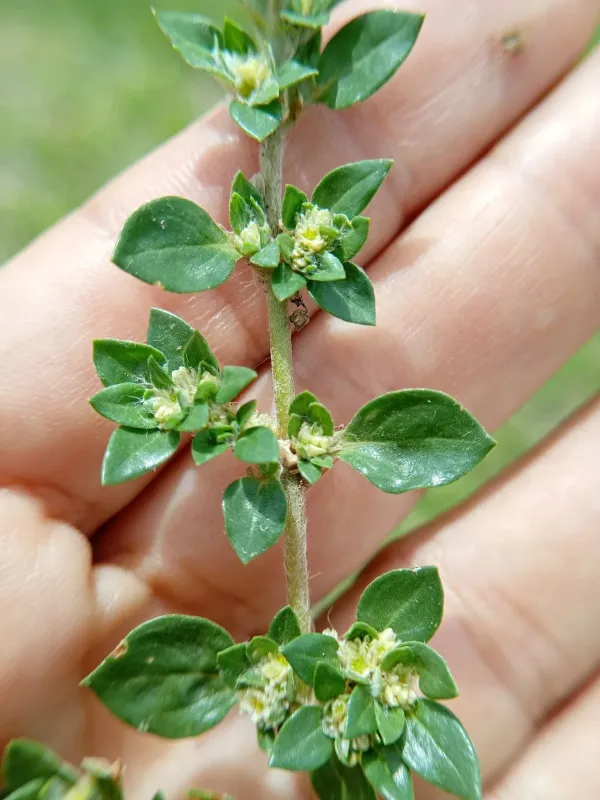
The leaves are opposite, elliptic to spatulate, and are often covered in fine, silvery hairs, which gives the entire plant a grayish-green appearance.
Flowers are inconspicuous, arranged in dense, axillary spikes that are often hidden within the foliage, making the plant difficult to detect until it is well-established.
It possesses a strong, deep taproot system, which serves as a vital survival mechanism, allowing the plant to persist in dry and degraded soil conditions.
Where it grows
Guilleminea densa is widely distributed across tropical and subtropical regions, particularly thriving in North, Central, and South America.
It is commonly found in disturbed sites, such as roadsides, pastures, dry waste areas, and agricultural fields where soil cover is incomplete.
The plant prefers sunny, open environments with well-drained sandy or rocky soils, showing high adaptability to hot and arid climates.
In farming systems, it typically infiltrates row crops and orchards, where it exploits spaces between rows that receive infrequent cultivation.
Its ability to tolerate significant physical disturbance makes it a persistent inhabitant of areas frequently crossed by farm machinery or livestock.
Harm it causes
The primary agricultural impact of small matweed is its intense competition for soil moisture and nutrients, especially in water-limited cropping systems.
The dense, mat-like growth habit allows the weed to rapidly shade out and suppress the emergence of crop seedlings in its immediate vicinity.
It can act as a host for various phytopathogens, potentially facilitating the transmission of viral or fungal diseases to neighboring agricultural crops.
The presence of large, established mats creates significant obstacles for harvesting equipment, which may cause mechanical delays or reduced harvest efficiency.
In pastures, it degrades the quality of forage by occupying space that would otherwise be used by more palatable and nutritious grass species.
How to control
Mechanical control is most effective when targeting the plant in its early growth stages; deep cultivation is necessary to severe the taproot.
Integrating cover crops into the rotation can provide necessary shading, which limits the light availability that this sun-loving weed requires for survival.
Chemical control usually requires systemic herbicides, although resistance and tolerance patterns must be evaluated based on the regional herbicide program.
Maintaining a healthy, dense canopy of the main crop is one of the most effective non-chemical strategies for suppressing small matweed germination.
- Regular mechanical hoeing between crop rows.
- Application of selective systemic herbicides at early growth stages.
- Implementation of crop rotations that increase competitive pressure.
Taxonomy
- Latin name
- Guilleminea densa
- Family
- Амарантовые
- EPPO code
- GUMDE