
Gomphrena celosioides
Gomphrena celosioides
Description
How to tell it apart
Gomphrena celosioides, commonly known as celosia-like globe amaranth, belongs to the Amaranthaceae family and is a prostrate herbaceous perennial weed.
The plant features spreading, hairy stems that often root at the nodes, forming dense mats that cover the soil surface effectively and compete with crops.
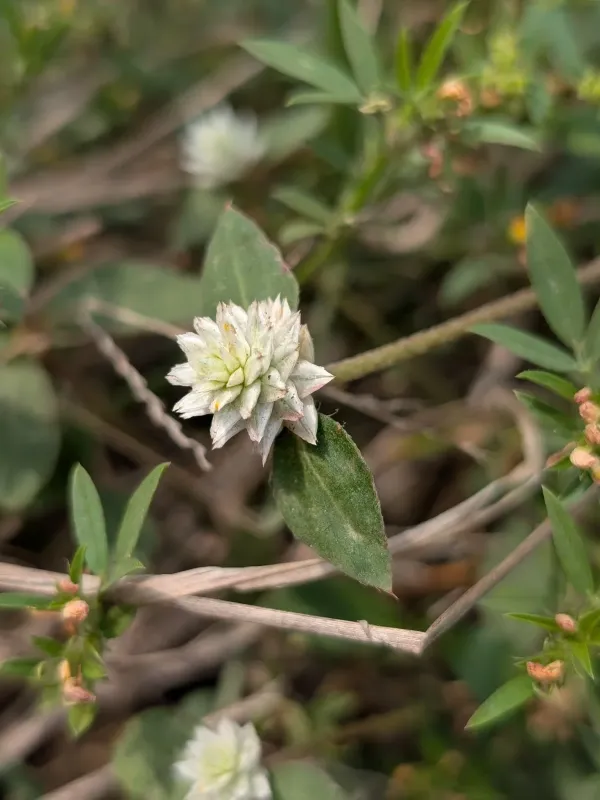
Leaves are opposite, lanceolate or spatulate, and covered with fine hairs. This pubescence is a key diagnostic feature used to distinguish it from similar species.
The flower heads are white or pale yellow, dense, and spherical to cylindrical, visually resembling the inflorescences of the genus Celosia.
It possesses a strong, deep taproot, which provides the plant with significant resilience against physical removal and enables survival in harsh environmental conditions.
Where it grows
This species is native to South America but has become a widespread invasive weed in many tropical and subtropical regions across the globe.
It thrives in disturbed areas, roadsides, pastures, and uncultivated fields, often spreading along tracks and pathways frequented by human activity.
In agricultural settings, it frequently infests row crops, vegetable gardens, and orchards, where it rapidly colonizes bare soil between crop plants.
The weed is highly adaptable to various soil types, particularly sandy and well-drained soils, though it can persist in compacted or degraded environments.
Dispersal is primarily mediated by human machinery and agricultural implements, making it a common contaminant in areas where regular field cultivation occurs.
Harm it causes
Gomphrena celosioides competes intensely with crops for water, light, and essential soil nutrients, often resulting in significant yield reduction in heavily infested fields.
It acts as a primary competitor in early stages of crop growth, especially in legumes and vegetable crops where it can quickly outgrow the seedling phase.
The weed is known to serve as a reservoir for various plant viruses and pathogens, which can then spread to neighboring cultivated crops, causing disease outbreaks.
Livestock may face health risks if the weed is present in large quantities in pastures, as some studies suggest potential toxicological effects if ingested regularly.
The dense mats formed by the plant interfere with mechanical operations, such as hoeing and harvesting, increasing the operational costs for farmers.
How to control
Effective management requires an integrated approach that combines mechanical cultivation with appropriate chemical control measures to limit seed production.
Cultural practices such as deep plowing can help disrupt the root system and bury the seeds, preventing them from germinating in the following growing season.
Preventive measures are crucial, including the use of certified seed and ensuring that agricultural equipment is cleaned before moving between fields to prevent dispersal.
Chemical control involving systemic herbicides is often necessary for large infestations, particularly when applied during the active growth phase before flowering.
- Regular mechanical inter-row cultivation.
- Spot spraying with systemic herbicides.
- Rigorous monitoring and sanitation of field margins.
- Crop rotation to break the weed's life cycle.
Taxonomy
- Latin name
- Gomphrena celosioides
- Family
- Амарантовые
- EPPO code
- GOMCE