
Slender cottonweed
Froelichia gracilis
Description
How to tell it apart
Slender cottonweed (Froelichia gracilis) belongs to the Amaranthaceae family. It is an annual herbaceous plant with an erect or branched stem, typically reaching 10 to 60 centimeters in height.
The leaves are elongated-lanceolate or spatulate in shape and are arranged oppositely. The surface of the stems and leaves is covered with dense, silvery-white hairs, giving the plant a characteristic fuzzy appearance.
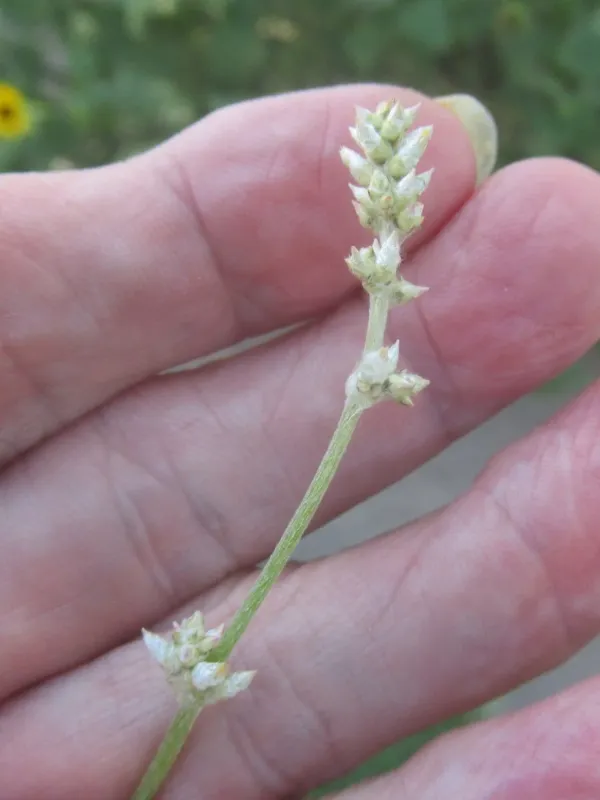
The inflorescences consist of spiky, head-like clusters at the tips of the stems. The flowers are small, inconspicuous, and possess bracts that persist on the plant after flowering, forming dense, prickly structures.
The root system is a well-developed taproot, which allows the plant to survive in moisture-limited conditions. The seeds are small and possess high potential for dispersal by wind and water.
The plant is heat-loving and heliophilic, preferring open, well-lit areas with light sandy or loamy soils, which determines its adaptability to various agro-ecosystems.
Where it grows
Slender cottonweed is native to North America, but as an introduced species, it is found in many regions with similar climatic conditions. It favors disturbed lands, roadsides, and waste areas.
In the agricultural sector, the weed actively colonizes row crops such as corn, soybeans, and sunflowers. It is particularly dangerous in fields with low-level agronomic management.
The plant adapts well to dry habitats and is often found in fields with light, degraded soils, where competition from crops is reduced.
It frequently appears as a secondary weed in cereal crop fields if sowing dates coincide with the active germination phase of this species in late spring.
Spread within agricultural lands often occurs through contaminated seed material or machinery moving between fields during the weed's seed maturation period.
Harm it causes
The primary damage results from intense competition with crops for space, moisture, and mineral nutrients, leading to significant yield reductions.
The presence of slender cottonweed in the field complicates harvesting, especially when using combines, as the prickly inflorescences clog machinery parts and reduce grain quality.
The weed acts as a reservoir for various pests and pathogens that can spread to major agricultural crops, complicating the overall phytosanitary situation.
The biological characteristics of the species allow it to quickly form dense populations capable of completely suppressing the growth of crop seedlings in early stages.
High seed production contributes to the rapid accumulation of a seed bank in the soil horizon, making long-term control efforts necessary.
How to control
Agronomic methods include high-quality primary and pre-sowing soil tillage aimed at inducing seed germination followed by their destruction through cultivation.
Adherence to crop rotation, including crops that provide high canopy density, helps significantly reduce weed development by shading the soil.
- Use of systemic herbicides on actively growing plants during early development stages.
- Application of pre-emergence soil-applied herbicides to suppress seed germination before crop establishment.
Rigorous control of seed cleanliness and regular cleaning of agricultural equipment operating in infested fields are essential practices.
In cases of mass emergence, mechanical inter-row cultivation in row crops is recommended to eliminate weeds during critical growth phases.
Taxonomy
- Latin name
- Froelichia gracilis
- Family
- Амарантовые
- EPPO code
- FROGR