
Dysphania cristata
Dysphania cristata
Description
How to tell it apart
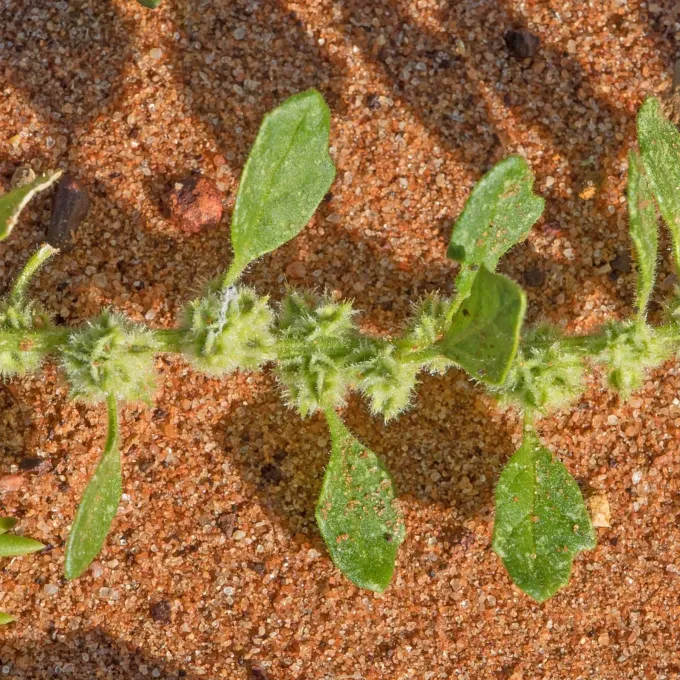
Dysphania cristata is a herbaceous annual plant belonging to the Amaranthaceae family. It is easily identified by its prostrate growth habit and distinctive, branched stems that create dense, mat-like patches on the soil surface.
The plant typically reaches a height of 5 to 20 centimeters. Its stems are covered in glandular hairs that emit a characteristic aromatic scent, common among several species within the Dysphania genus.
The leaves are oblong with serrated or pinnately lobed margins. This morphology helps the plant maximize photosynthesis even under conditions of high temperature and intense sunlight.
Flowers are minute, grouped in tight, spike-like inflorescences located at the terminals of branches or within leaf axils. These structures are designed for efficient wind pollination and rapid seed production.
The fruits are small nuts encased in a persistent perianth, which protects the seed during unfavorable environmental conditions and helps it persist in the soil seed bank for several years.
Where it grows
Dysphania cristata thrives in open, disturbed habitats, often colonizing sandy or gravelly soils. It is frequently observed along roadsides, in wasteland areas, and on dry, overgrazed pastures.
In agricultural settings, it appears in row crops, particularly where soil cover is insufficient. It is highly resilient and can withstand prolonged periods of drought, allowing it to dominate in harsh climates.
The species has an expanding geographical range, facilitated by modern machinery and the global movement of goods. It is increasingly becoming a problem in regions where agricultural practices create open niches for invasive weeds.
On farms, the weed often congregates in areas with thin crop stands. By exploiting the lack of canopy competition, Dysphania cristata rapidly establishes itself and expands its coverage.
The ability of its seeds to remain dormant in the soil ensures that the weed persists even when management efforts are intermittent, making it a difficult weed to eradicate completely.
Harm it causes
The primary damage caused by Dysphania cristata involves competition with crops for essential nutrients and water. In the early stages of crop development, the presence of this weed can lead to stunted crop growth.
Because it grows close to the ground, it often escapes mechanical cultivation in row crops, allowing it to complete its reproductive cycle and add millions of seeds to the soil seed bank.
It can also act as a host for various agricultural pests and viruses. This complicates pest management, as the weed provides a reservoir for insects that eventually migrate to the crop.
Contamination of the harvested product with seeds is another significant issue. This leads to increased processing costs at harvest and may result in downgrading the quality of the agricultural produce.
Mass infestations significantly reduce overall crop yields. The combination of resource competition and potential pest hosting makes it an economically significant weed in susceptible environments.
How to control
Effective management begins with mechanical practices such as deep tillage. Burying the seeds at sufficient depths prevents germination and reduces the number of seedlings that emerge in subsequent seasons.
Crop rotation remains a key strategy; incorporating competitive crops that form a dense canopy suppresses the weed by limiting the sunlight available for its growth. Timely harrowing is also highly effective for young seedlings.
Chemical control often involves the use of pre-emergent herbicides to stop germination. The selection of chemicals depends on the specific crop and local soil characteristics, ensuring safety for the desired plant.
Post-emergent herbicide applications are necessary when the weed escapes early control measures. It is crucial to apply these treatments before the plant reaches its flowering stage to prevent seed formation.
Biosecurity on the farm, including cleaning harvesting equipment between fields, is essential for long-term control. Preventing the introduction of new seeds is the most cost-effective approach to managing this weed.
Taxonomy
- Latin name
- Dysphania cristata
- Family
- Амарантовые
- EPPO code
- CHECR