
Carinate goosefoot
Dysphania carinata
Description
How to tell it apart
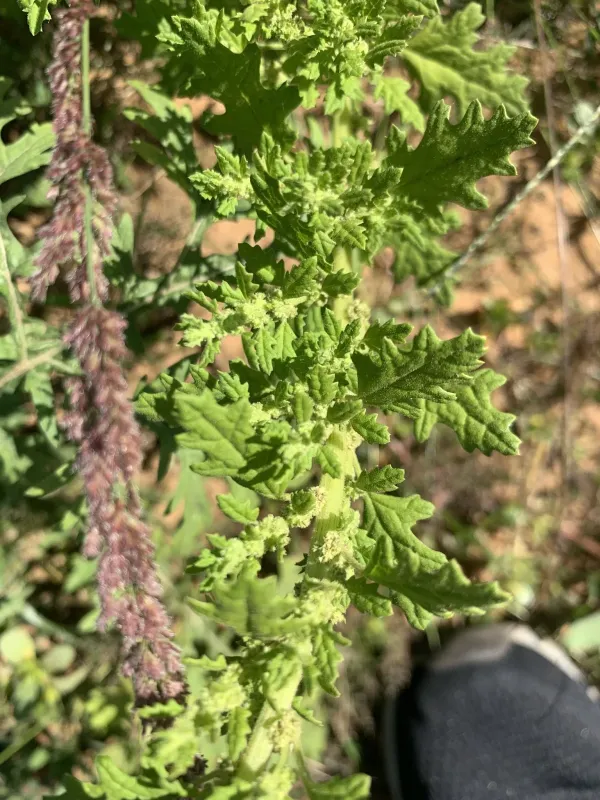
Carinate goosefoot (Dysphania carinata) is an annual herbaceous plant belonging to the Amaranthaceae family. It is distinguished by the specific structure of its perianth, which becomes keeled (carinate) as the fruits mature, providing the common name for the species.
The plant has a distinct, somewhat pungent aroma due to the numerous glandular hairs covering its stems and leaves. It typically grows to a height of 20 to 50 centimeters and often exhibits a branched, upright growth habit.
The leaves are alternate, oblong to ovate, and have serrated margins. The leaf surface often appears rough or dusty due to the dense glandular pubescence, which serves as a key identifying characteristic in the field.
Small greenish flowers are clustered in dense spike-like or paniculate inflorescences in the leaf axils. Flowering generally occurs during the summer, coinciding with the active growing phase of many agricultural crops.
The fruits are tiny nutlets enclosed within the persistent perianth. The seeds are highly resilient and can remain viable in the soil for several years, ensuring long-term persistence in infested areas.
Where it grows
This weed commonly thrives in disturbed soils, including field edges, roadsides, and waste grounds. In agricultural settings, it is particularly prevalent in row crops and vegetable fields.
Carinate goosefoot is highly adaptable to various soil types, ranging from dry, sandy soils to more fertile, disturbed substrates. It easily colonizes gaps in crop stands where competition from cultivated plants is low.
Dissemination is often facilitated by farm machinery, which carries seeds between fields, as well as by contaminated seed lots or irrigation water moving through drainage ditches.
It acts as a colonizer on the margins of fields, slowly encroaching upon cultivated land if left unmanaged during the early stages of its establishment.
The plant's ability to complete its life cycle under diverse environmental conditions makes it a persistent weed that can quickly populate abandoned or poorly maintained crop areas.
Harm it causes
The primary damage caused by carinate goosefoot is its intense competition for soil moisture and nutrients, which directly leads to reduced crop yield and lower plant vigor.
By emerging early and growing rapidly, it shades the surrounding crop plants, suppressing their photosynthetic efficiency and slowing down overall development during critical growth stages.
The glandular hairs on the plant surface can collect dust and potentially harbor various microbes, which may negatively impact the phytosanitary environment of the crop field.
During harvest, the succulent green mass of the weed can obstruct combine harvesters and increase the moisture content of the harvested grain, leading to higher post-harvest processing costs.
Contamination of harvested grain with goosefoot seeds reduces the product's market quality and requires additional cleaning steps to meet commercial standards.
How to control
Effective management of carinate goosefoot requires an integrated approach that combines mechanical cultivation with timely chemical intervention.
Adhering to a well-planned crop rotation is the foundation of long-term control, as it prevents the weed from building up a large seed bank in the soil over time.
- Deep plowing to bury seeds, which prevents successful germination.
- Pre-emergence harrowing to destroy weed seedlings before the crop establishes.
- In-season row cultivation to remove weeds between rows in row crops.
- Mowing of field margins and non-cropped areas to prevent seeds from reaching maturity.
Chemical control is most effective when herbicides are applied early in the weed's development, specifically at the cotyledon to 2-4 true leaf stages.
The use of tank mixes or sequential herbicide applications can improve results, providing broad-spectrum control and effectively managing infestations of carinate goosefoot alongside other common weeds.
Taxonomy
- Latin name
- Dysphania carinata
- Family
- Амарантовые
- EPPO code
- CHECN