
Mexican tea
Dysphania ambrosioides
Description
How to tell it apart
Mexican tea (Dysphania ambrosioides), formerly known as Chenopodium ambrosioides, is a member of the Amaranthaceae family. It is an annual or short-lived perennial plant with branched stems that can grow up to one meter in height.
The leaves are lanceolate or oblong with toothed edges. A key identifying feature is the plant's intense, pungent aroma, often compared to a mixture of lemon and kerosene, caused by essential oils stored in glandular hairs on the foliage.
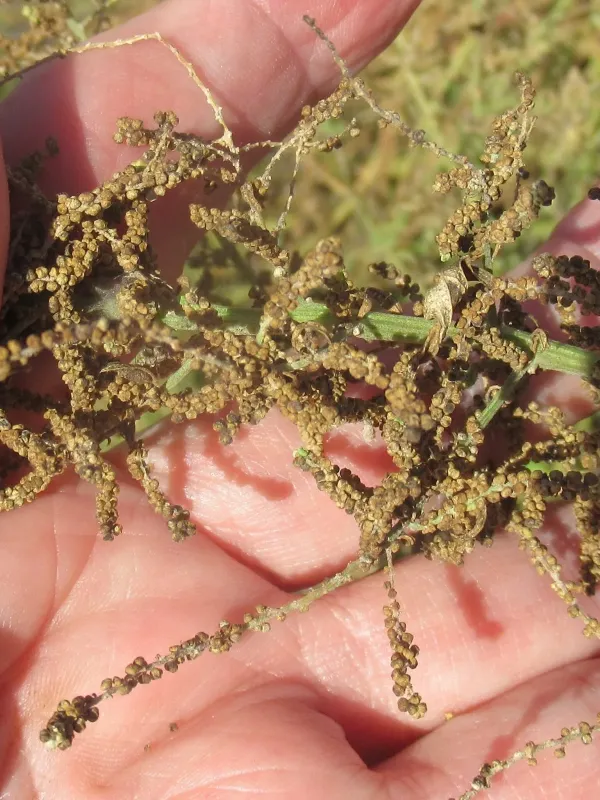
The flowers are small and greenish, arranged in dense paniculate clusters located at the leaf axils. The seeds are minute, smooth, and dark brown or black, making them difficult to separate from small-seeded crops.
The root system is taprooted and well-developed, allowing the plant to thrive in various soil types and compete successfully for resources even in dry conditions.
It is a highly prolific seed producer, with a single plant capable of shedding thousands of seeds that can persist in the soil seed bank for several years.
Where it grows
Mexican tea is a sun-loving plant that prefers well-drained, fertile soils. It is frequently found in disturbed habitats such as roadsides, wastelands, and abandoned fields.
In agricultural settings, it poses a significant threat to row crops like corn, sunflowers, and various vegetables. Its fast growth rate allows it to quickly occupy vacant spaces in fields.
The plant is highly adaptable and can survive in a wide range of climates, moving easily from wild areas into cultivated lands where management practices are insufficient.
Seed dispersal is facilitated by wind, water, and human activity, particularly through the movement of farm machinery, which effectively spreads the weed across large agricultural operations.
Fields with poor crop rotation or inadequate soil management are particularly susceptible to heavy infestations of this resilient species.
Harm it causes
The primary damage caused by Mexican tea is the direct competition with crops for nutrients, sunlight, and moisture, which leads to substantial yield losses in infested fields.
Through allelopathy, the plant releases chemicals into the soil that can inhibit the germination and development of adjacent crop species, further reducing plant density.
Contamination of the harvest with Mexican tea seeds degrades product quality and purity, often necessitating costly post-harvest cleaning and processing steps.
The plant serves as a host for various viruses and pests that can subsequently migrate to primary crops, forcing producers to increase their pesticide applications.
High densities of this weed interfere with harvesting equipment, increase the moisture content of grain, and lead to overall operational inefficiencies during the season.
How to control
Mechanical control measures include deep autumn plowing to bury seeds deep enough to prevent emergence, combined with precise inter-row cultivation before the plant sets seeds.
Crop rotation serves as a critical strategy, particularly by using competitive small grains that can shade out the weed and limit its ability to establish during the early season.
Chemical control involves the use of selective herbicides applied during the early vegetative stage of the weed to maximize efficacy before the plant becomes resistant.
Integrated weed management must prioritize field hygiene to prevent the spread of seeds via equipment, as well as regular monitoring to spot and destroy isolated patches early.
- Utilize pre-emergence soil herbicides for early-season suppression.
- Implement rigorous sanitation protocols for all agricultural machinery.
- Targeted chemical application during the seedling stage.
Taxonomy
- Latin name
- Dysphania ambrosioides
- Family
- Амарантовые
- EPPO code
- CHEAM