
Cyphocarpa angustifolia
Cyphocarpa angustifolia
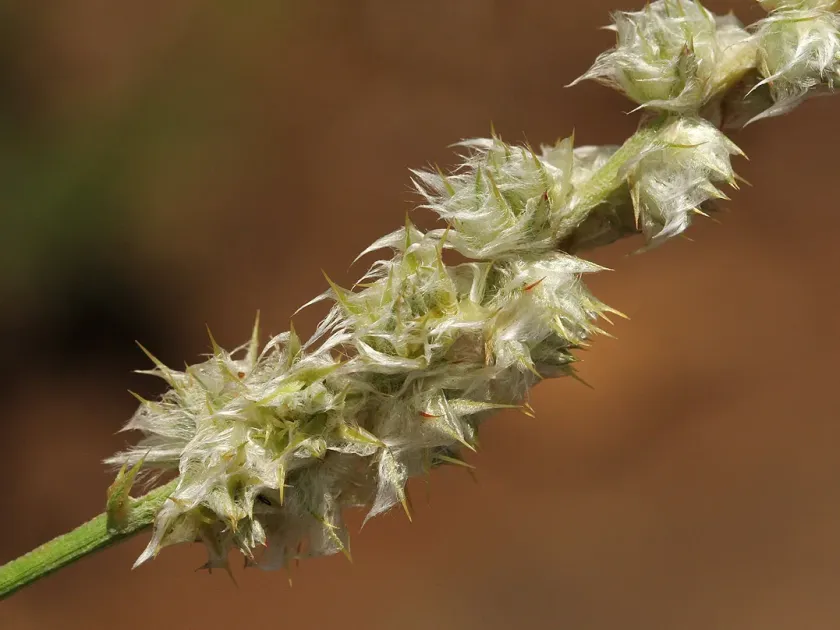
Description
How to tell it apart
Cyphocarpa angustifolia belongs to the Amaranthaceae family. It is a perennial herbaceous plant characterized by narrow, linear leaves arranged oppositely along the stems.
The plant possesses a robust root system, allowing it to survive in arid environments and recover quickly from mechanical disturbances or grazing pressure.
Its flowers are small and arranged in spike-like inflorescences, producing a high volume of seeds that ensures the weed persists through diverse environmental conditions.
Morphologically, the plant exhibits high plasticity, growing either as a sprawling mat or an upright bush, depending on soil quality and water availability.
Correct identification requires close examination of leaf shape and inflorescence structure, as it shares common traits with other species in the Amaranth family.
Where it grows
This species is primarily distributed across southern regions of Africa, where it thrives in arid and semi-arid ecosystems.
It is commonly found on pastures, fallow lands, and along roadsides, where it can easily establish itself in disturbed or degraded soils.
In agricultural settings, Cyphocarpa angustifolia can become a significant weed in cereal and forage crop production, particularly in drought-prone areas.
The weed prefers sandy and loamy soils with low fertility levels but can successfully colonize degraded farmland where competition is minimal.
Seed dispersal is facilitated by wind and human activity, including the movement of farm machinery, which accelerates its spread across agricultural landscapes.
Harm it causes
The main threat posed by Cyphocarpa angustifolia is its high competitive ability for water and soil nutrients, which is critical in arid farming systems.
As it spreads, the weed creates a dense cover that suppresses crop emergence and stunts the development of seedlings by limiting light and nutrient uptake.
Its deep root system allows it to access soil moisture from lower profiles, severely impacting the yields of crops during prolonged dry spells.
On rangelands, the plant displaces valuable forage species, leading to a decline in the overall quality and carrying capacity of grazing land for livestock.
Contamination of harvested grain with its seeds necessitates additional costs for cleaning and processing, reducing the market value of the crop.
How to control
Agrotechnical management includes deep autumn plowing to break down the root system and bury seeds to a depth that prevents successful germination.
Strategic inter-row cultivation during the early stages of crop growth is highly effective in curbing the weed's spread before canopy closure.
Chemical control involves the application of systemic herbicides during the plant's active vegetative growth phase, prior to the onset of flowering.
Implementing crop rotations with dense-canopy species provides natural suppression by shading the soil surface and limiting the light available to weeds.
- Consistent field scouting to identify and contain emerging infestations.
- Manual removal of individual plants before seed production begins.
- Ensuring seed purity in commercial planting materials.
- Applying targeted post-emergence herbicides for effective suppression.
Taxonomy
- Latin name
- Cyphocarpa angustifolia
- Family
- Амарантовые
- EPPO code
- CZCAN