
Celosia argentea
Celosia argentea
Description
How to tell it apart
Celosia argentea is an annual herbaceous plant belonging to the Amaranthaceae family. It features an erect, heavily branched stem that can grow anywhere from 30 to 100 cm tall, depending on the environmental conditions.
The leaves are lanceolate or ovate in shape, arranged alternately, and often possess a pointed tip. The surface of the leaf is smooth and vibrant green, occasionally showing a reddish tint at the base.
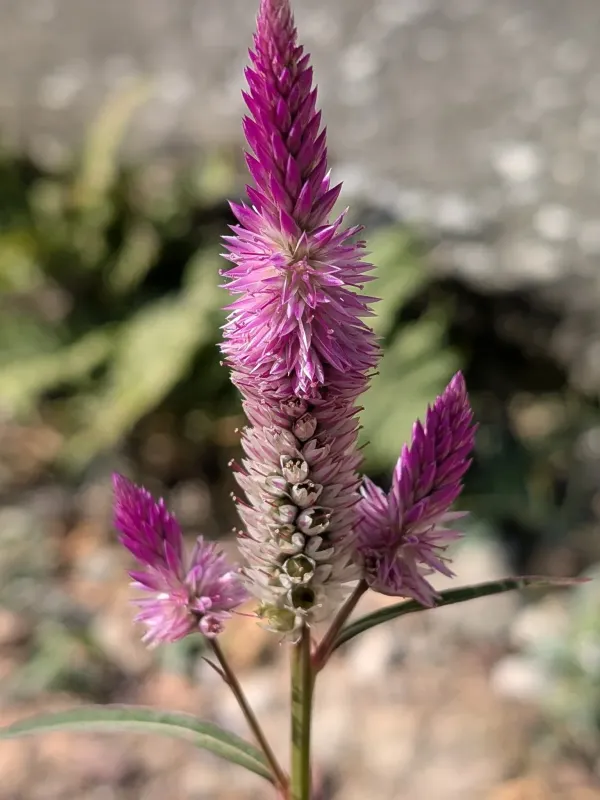
The inflorescences of Celosia consist of dense spike-like or paniculate structures. In wild, weed-type forms, these are typically silvery-white or pale pink, which gives the plant a distinct appearance as it matures.
The plant has a well-developed taproot system that can penetrate deep into the soil, allowing the weed to survive during periods of moderate drought.
The seeds are small, spherical, or slightly flattened, with a dark brown or black color and a noticeable sheen. A single plant is capable of producing thousands of seeds throughout its growing season.
Where it grows
This species prefers well-lit, sun-exposed areas with loose, fertile soil. It is most commonly found in tropical and subtropical regions, from which it has spread to other parts of the world.
In agricultural settings, Celosia argentea is frequently seen in row crops such as maize, soybeans, cotton, and various vegetable crops. It also commonly infests fallow land and field margins.
The plant is an aggressive colonizer of disturbed land, abandoned fields, and plantations with low crop density. It can quickly overtake areas thanks to the high germination rate of its seeds.
Biologically, Celosia is a thermophilic species; therefore, mass emergence typically occurs in late spring and early summer when soil temperatures are sufficiently high.
It easily adapts to various soil types, including loams and sandy soils, provided there is enough moisture to support the initial development of its root system.
Harm it causes
The damage caused by Celosia argentea is primarily due to its ability to outcompete crops for sunlight, soil nutrients, and moisture.
Because of its rapid growth rate during the early stages of development, this weed can significantly suppress crop growth, leading to direct yield losses and reduced quality of the harvested produce.
The plant can act as a potential reservoir for various pests and viral diseases that may subsequently spread to essential agricultural crops.
In cases of high infestation, Celosia complicates mechanical field operations and harvesting processes while increasing seed contamination in harvested grain, necessitating extra costs for cleaning.
A high density of this weed in a field can lead to the critical depletion of available nitrogen and micronutrients specifically needed for the main crop's development.
How to control
The primary agronomic method for control is the implementation of a proper crop rotation system, which involves alternating crops with different root structures and growth periods.
Quality inter-row cultivation in row crops, performed before the canopy closes, plays a vital role in control, as does the use of mulching to suppress seed germination.
Chemical control includes the application of pre-emergence and post-emergence broad-spectrum herbicides. It is crucial to perform treatments during the early stages of the weed's development when it is most susceptible.
Deep plowing of the field is recommended to bury the weed seeds at a depth from which they cannot emerge, effectively reducing the soil seed bank.
A comprehensive management strategy requires constant field monitoring and the removal of isolated Celosia plants before they begin to flower to prevent further spread of the seed material.
Taxonomy
- Latin name
- Celosia argentea
- Family
- Амарантовые
- EPPO code
- CEOAR