
Brayulinea densa
Brayulinea densa
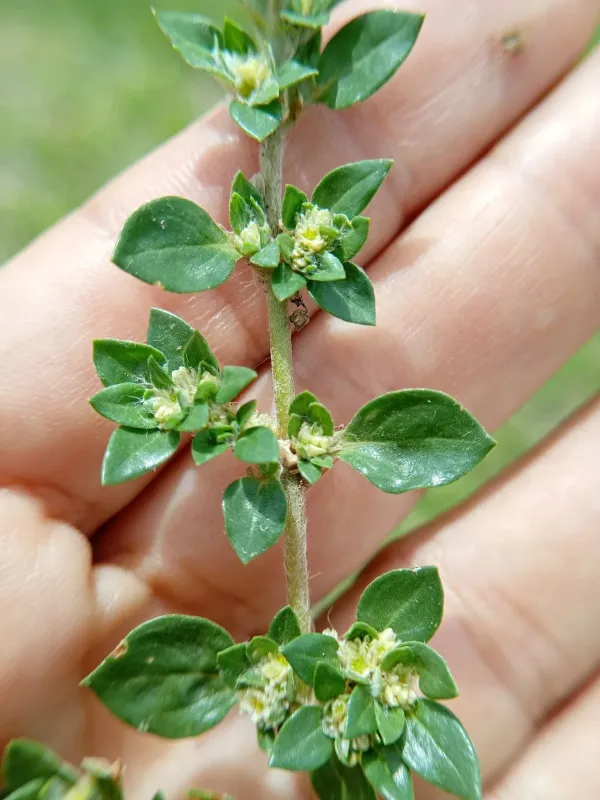
Description
How to tell it apart
Brayulinea densa belongs to the Amaranthaceae family. It is an annual herbaceous plant characterized by a low-growing, often prostrate habit, which allows it to form dense mats across the soil surface.
The stems are heavily branched and covered in small, alternate, entire leaves. The leaf blades are often pubescent, giving the plant a grayish or silvery appearance, which serves as a key diagnostic feature.
The flowers are extremely small and arranged in dense, compact globose or spicate inflorescences located in the leaf axils. It is this density of the inflorescences that earned the plant its specific epithet, "densa."
The root system is taprooted but sufficiently branched to anchor the plant in dry soils. The seeds are small and easily dispersed by wind, water, or farm machinery, ensuring the rapid spread of the species.
This plant exhibits high adaptability to various soil types, preferring well-lit areas. Unlike many other amaranth species, it does not reach significant heights, allowing it to hide under the canopy of cultivated crops.
Where it grows
Brayulinea densa is most commonly found in regions with warm climates. It prefers open, dry, and disturbed areas, including roadsides, wasteland, pastures, and territory surrounding agricultural facilities.
In fields, it harms row crops such as corn, sunflower, and soybeans. Because of its compact form, it is particularly dangerous during the early stages of crop development when the weed quickly occupies free space between rows.
The plant effectively colonizes areas with disrupted soil cover. In regions of active spread, it is frequently encountered in vegetable crop rotations where irrigation and fertilizers create a favorable environment.
The weed is often found on uncultivated land adjacent to fields. This creates a constant source of infestation, from which seeds are carried by the wind onto cultivated acreage.
Due to its ability to grow quickly in conditions of water scarcity, Brayulinea densa becomes a serious competitor in arid zones, where it can displace less resilient crop species and native vegetation.
Harm it causes
The primary harm caused by Brayulinea densa lies in its high competitiveness for moisture and nutrients. Because the plant has a robust metabolism, it rapidly depletes the soil in the root zone of cultivated crops.
The weed creates a dense soil cover that interferes with normal aeration and soil warming. This delays the development of crop root systems and can lead to the development of fungal diseases due to increased humidity in the root zone.
Brayulinea densa can act as a reservoir for various pests and viral diseases. The presence of this weed in fields significantly complicates phytosanitary conditions and necessitates additional expenses for insecticide treatment.
During the flowering and fruiting period, the weed produces a large number of seeds, leading to a rapid accumulation in the soil seed bank. This makes control a long-term process requiring a systematic approach.
The presence of the weed at harvest time can complicate the operation of agricultural machinery, clogging combine parts and reducing the quality of the grain due to vegetative debris contamination.
How to control
Agrotechnical measures include deep autumn plowing, which allows seeds to be buried at a depth that prevents germination. Regular inter-row cultivation in row crops effectively suppresses young seedlings.
Crop rotation using species that form a dense canopy (e.g., winter cereals) limits light access to Brayulinea densa, suppressing its growth during the early vegetative period.
Chemical control is based on the application of systemic herbicides. Products based on glyphosate (on fallow land) or selective herbicides for controlling broad-leaved weeds in crop fields are effective.
It is crucial to perform timely chemical treatment before the active flowering phase begins. Later applications of pesticides become less effective as the plant develops a tough cuticle and seed reserves may already be established.
- Provoking germination through shallow soil tillage.
- Using herbicides during the early stages of weed development.
- Clearing field edges and surrounding areas of wild populations.
- Timely harvesting to prevent seed shattering.
Taxonomy
- Latin name
- Brayulinea densa
- Family
- Амарантовые
- EPPO code
- BRYDE