
Blutaparon vermiculare
Blutaparon vermiculare
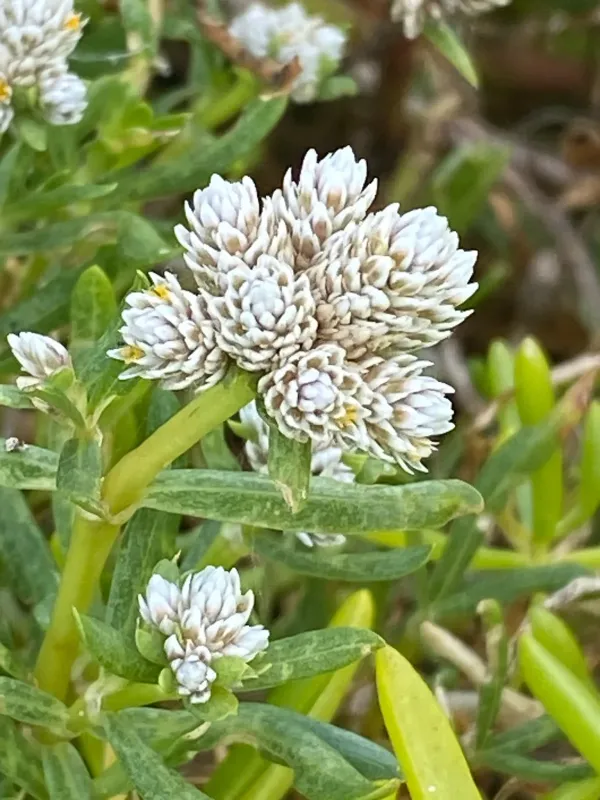
Description
How to tell it apart
Blutaparon vermiculare is a perennial herb belonging to the Amaranthaceae family. It is characterized by its prostrate growth habit, often forming dense mats that can quickly cover large areas of arable land.
The stems are succulent and capable of rooting at the nodes, which facilitates efficient vegetative reproduction. The leaves are opposite, fleshy, and typically linear or lanceolate in shape.
The inflorescences consist of dense, worm-like cylindrical heads, which serve as the primary diagnostic feature for identifying the species in the field. The flowers are small, white to yellowish, and hidden by bracts.
As a biological entity, this plant is classified as an expansive perennial weed. It possesses high environmental plasticity, allowing it to thrive in diverse moisture conditions.
The seeds are small and highly viable, ensuring the plant can persist in the soil seed bank and recolonize areas following mechanical disturbance or seasonal flooding.
Where it grows
This weed is native to coastal regions in tropical and subtropical zones. It naturally thrives in sandy soils, near beaches, salt marshes, and low-lying areas with high moisture levels.
In agricultural settings, Blutaparon vermiculare often infests irrigated crops, vegetable farms, and low-lying fields. It is particularly problematic in areas where moisture availability is high throughout the growing season.
The plant is salt-tolerant, which allows it to establish itself in saline soils where other competing vegetation might struggle to survive, giving it a distinct advantage.
Dispersal is frequently facilitated by water movement, such as floods and runoff, as well as the movement of contaminated farm machinery between different fields.
It prefers disturbed sites, making it a common colonizer of newly cleared or poorly managed agricultural lands near coastal or wetland zones.
Harm it causes
The weed causes significant harm by competing with crops for essential nutrients, water, and sunlight. Its prostrate growth form creates a cover that smothers emerging crop seedlings.
Mechanical removal is challenging due to the plant's ability to root from stem fragments. Even small pieces left behind after plowing can regenerate into new plants.
Dense infestations can impede harvesting equipment, leading to equipment clogging, increased operational time, and reduced efficiency during field work.
Blutaparon vermiculare can harbor various pests and plant pathogens, acting as an alternative host that necessitates additional chemical treatments for crop protection.
Yield loss is common in heavily infested fields, as the competitive pressure from the weed stunts the development of the primary crop's root system.
How to control
Effective control involves a combination of deep plowing to uproot the plants and consistent inter-row cultivation to prevent the establishment of vegetative runners.
Water management is a critical preventive measure. Improving field drainage to reduce excessive soil moisture makes the environment significantly less favorable for this species.
Chemical control usually requires systemic herbicides. However, due to the succulent nature of the leaves, thorough coverage and the use of appropriate surfactants are necessary for maximum efficacy.
Integrated weed management should prioritize controlling the weed before it flowers to prevent the dispersal of seeds and the expansion of the seed bank.
- Manual removal of small patches early in the season.
- Sanitation of equipment to prevent the spread of stem fragments.
- Use of crop rotation to break the cycle of infestation in low-lying areas.
Taxonomy
- Latin name
- Blutaparon vermiculare
- Family
- Амарантовые
- EPPO code
- PHJVE