
Axyris amaranthoides
Axyris amaranthoides
Description
How to tell it apart
Axyris amaranthoides, commonly known as Russian pigweed, belongs to the Amaranthaceae family. It is an annual herbaceous plant often confused with Amaranthus species due to its inflorescence structure.
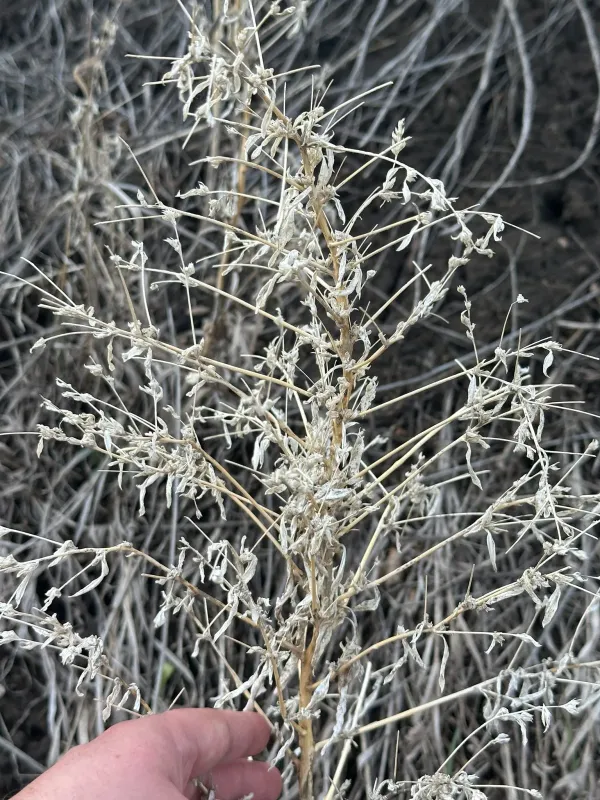
The plant features an erect, branched stem covered with small, pressed hairs, typically reaching a height of 20 to 80 centimeters depending on environmental conditions.
Leaves are alternate, lanceolate or oblong, with entire margins, and exhibit a grayish-green color due to the fine pubescence covering their surfaces.
Flowers are arranged in dense, spike-like panicles at the tips of the stems and branches, which gives the plant its characteristic appearance during the flowering stage.
The fruit is a compressed achene, typically brown or gray, which possesses a high ability to remain dormant and viable in the soil for several growing seasons.
Where it grows
This weed is widely distributed in steppe and forest-steppe regions, thriving in open areas with high solar exposure and sufficient nutrient availability in the soil.
It is particularly problematic in spring cereal crops, vegetable gardens, and row crops like corn and sunflower, where it can rapidly dominate if left unchecked.
The plant is commonly found on roadsides, fence lines, fallow land, and abandoned fields, providing a constant source of seeds that can spread to cultivated fields.
Axyris amaranthoides shows great phenotypic plasticity, allowing it to adapt to various soil types, ranging from sandy and well-drained soils to slightly saline conditions.
Its ability to disperse seeds through wind, water, and agricultural machinery makes it a highly invasive species in agricultural landscapes across its distribution range.
Harm it causes
The main negative impact of Axyris amaranthoides is its strong competition for water and essential soil nutrients, which significantly suppresses crop growth during the early stages.
By forming dense stands, the weed shades out the seedlings of cultivated plants, severely restricting their access to sunlight and hindering photosynthetic efficiency.
In heavily infested fields, yield losses can be substantial, often reaching 20-30% depending on the severity of the infestation and the prevailing environmental conditions.
The weed complicates harvesting operations by increasing moisture content in the grain, leading to higher post-harvest processing costs and a decrease in crop quality.
Furthermore, Axyris amaranthoides can act as an alternative host for various agricultural pests and viral pathogens, creating a reservoir that threatens crop health.
How to control
The foundation of effective management involves an integrated approach combining agronomic practices and chemical control to deplete the soil seed bank systematically.
Deep autumn tillage is essential, as it buries the seeds deep into the soil profile, preventing them from germinating and ensuring they eventually lose viability.
Crop rotation remains a crucial strategy, as it allows farmers to switch between different herbicide modes of action and mechanical cultivation techniques to prevent resistance.
Chemical control should be implemented during the active growth phase, utilizing systemic herbicides that effectively target the plant without affecting the main crop.
- Utilizing clean, certified, and weed-free seed for sowing.
- Timely cultivation of fallow fields and edges to prevent seed set.
- Monitoring crop fields regularly to catch infestations at the early seedling stage.
Taxonomy
- Latin name
- Axyris amaranthoides
- Family
- Амарантовые
- EPPO code
- AXYAM