
Green amaranth
Amaranthus viridis
Description
How to tell it apart
Green amaranth (Amaranthus viridis) is an annual broad-leaved weed belonging to the Amaranthaceae family. It is a highly invasive species known for its rapid life cycle and seed production.
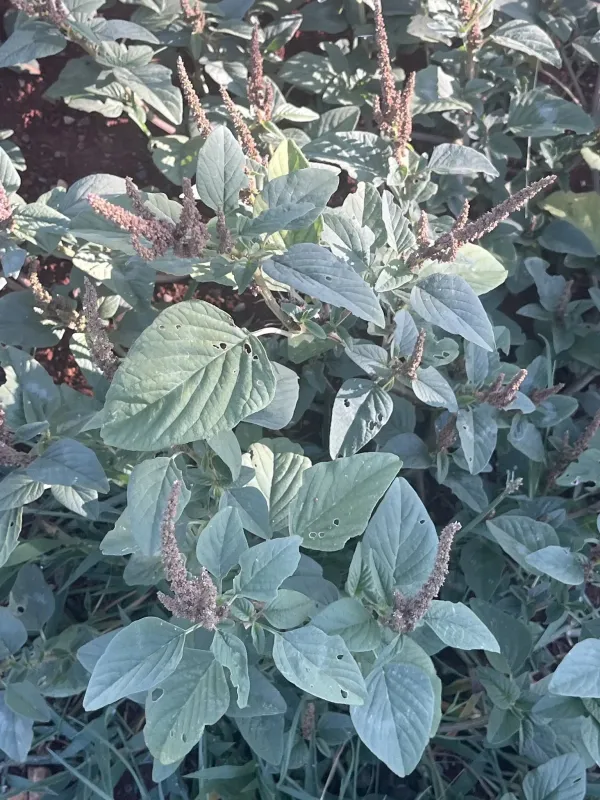
The plant typically grows 20 to 60 cm tall with a branched, upright stem. The leaves are alternate, ovate to rhombic-ovate, and possess long petioles, which is a characteristic feature for identification.
Its inflorescences are slender, green, terminal spikes or panicles located at the ends of stems and in leaf axils. The flowers are small, monoecious, and lack petals, making them easily distinguishable from other colorful amaranths.
The fruit is a small, indehiscent capsule that splits transversely, releasing tiny, round, glossy black seeds. A single plant can produce thousands of seeds, ensuring a robust soil seed bank.
It possesses a strong taproot system that allows it to thrive in various soil types and compete effectively for water during dry spells.
Where it grows
Green amaranth is a cosmopolitan weed, found primarily in tropical, subtropical, and warm temperate regions globally. It thrives in sunny, nitrogen-rich environments.
It is commonly found in disturbed sites, such as roadsides, orchards, and abandoned fields. It also frequently infests vegetable gardens and large-scale agricultural crop fields.
In agricultural settings, it is a significant competitor in summer row crops like maize, soybeans, and cotton, especially under irrigation, where moisture and nutrients are readily available.
The weed adapts well to various soil conditions but shows a preference for fertile, moist soils, often becoming a major issue in organic farming where manual or mechanical weeding is the primary method.
Its high adaptability allows it to establish quickly in cleared land, making it a persistent problem in regions with intensive land-use practices.
Harm it causes
The primary damage caused by Green amaranth is its aggressive competition with crops for water, sunlight, and soil nutrients, leading to stunted growth and reduced crop yields.
As a broad-leaved weed, it develops a large leaf surface area quickly, shading out younger crop seedlings and inhibiting their early-stage development and photosynthetic potential.
Green amaranth serves as a reservoir for several plant viruses, nematodes, and soil-borne pathogens, which can then spread to cultivated crops, increasing overall disease pressure.
Harvesting difficulties occur when the weed is present, as its biomass can clog machinery, increase moisture content in harvested grain, and introduce seed contamination.
- Significant yield losses ranging from 15% to 35% in infested fields.
- Increased production costs due to multiple herbicide applications.
- Long-term soil contamination with dormant seeds requiring multi-year control plans.
How to control
Effective control starts with integrated management, including crop rotation and the use of competitive cover crops that suppress weed growth by covering the soil surface.
Mechanical control, such as inter-row cultivation and hoeing during the early growth stages of the crop, is highly effective in managing young plants before they produce seeds.
Chemical control strategies often involve the use of pre-emergence herbicides to prevent germination, followed by post-emergence treatments using selective herbicides tailored to the crop variety.
Farmers must monitor field edges and surrounding areas to prevent the spread of wind-dispersed or machinery-transported seeds into primary cultivation zones.
Regular sanitation of farm machinery is crucial to prevent the accidental introduction of seeds from infested fields to clean areas, ensuring the longevity of effective control efforts.
Taxonomy
- Latin name
- Amaranthus viridis
- Family
- Амарантовые
- EPPO code
- AMAVI