
Thunberg's pigweed
Amaranthus thunbergii
Description
How to tell it apart
Thunberg's pigweed (Amaranthus thunbergii) belongs to the Amaranthaceae family. It is an annual herbaceous plant that typically adopts a prostrate or ascending growth habit.
The stems of the plant usually branch heavily from the base, reaching a length of 10 to 50 centimeters. They can exhibit either green or reddish shades, depending on light conditions and soil characteristics.
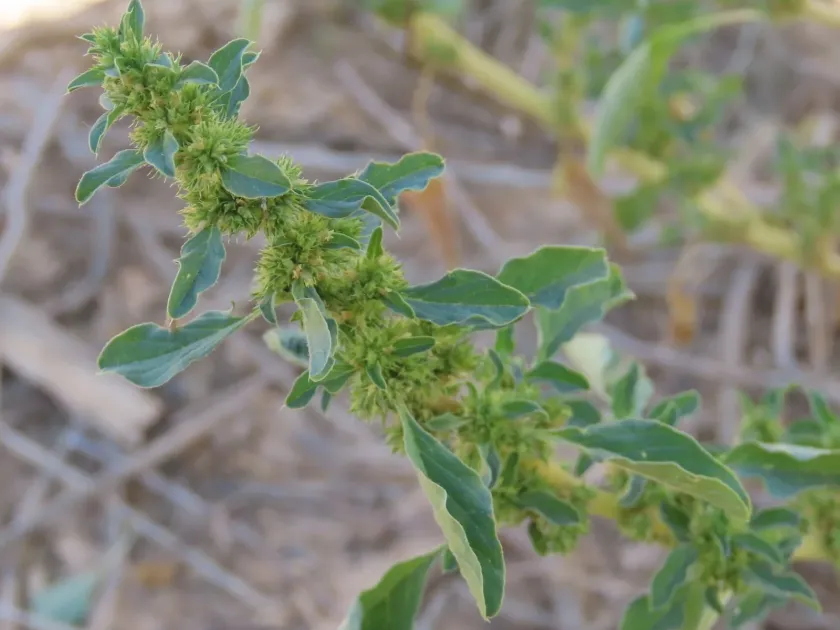
The leaves are rhombic-ovate or elliptic in shape and arranged alternately. The leaf margins are entire, often with a characteristic notch at the apex, which serves as a vital diagnostic feature for species identification.
The inflorescences consist of dense spicate clusters located both in leaf axils and at the tips of the shoots. The flowers are small, unisexual, with bracts that are longer than the perianth, giving the spikes a prickly appearance.
The seeds of this pigweed are small, rounded, and black or dark brown with a glossy surface. One plant can produce thousands of seeds that remain viable in the soil for many years.
Where it grows
This weed species is a cosmopolitan plant, though it is most commonly found in regions with warm and temperate climates. It thrives in diverse geographical conditions across the globe.
Thunberg's pigweed frequently infests row crops, vegetable plantations, and orchards. It is highly tolerant of various soil compositions but prefers well-warmed areas with adequate light levels.
The plant actively colonizes disturbed lands, roadsides, wastelands, and field edges. Due to its high seed production, it spreads rapidly along agricultural machinery paths.
In fields, it harms late-sown spring crops such as corn, sunflowers, and sugar beets. It can also be found in soybean agroecosystems, where it competes with crops for limited resources.
It tolerates periodic soil compaction and low nutrient content, making it a dangerous competitor in depleted or poorly managed agricultural fields.
Harm it causes
The primary damage lies in intense competition with crops for moisture and mineral nutrients, especially during the early stages of crop development.
Due to its vigorous growth and biomass production, this pigweed can heavily shade crop seedlings, leading to stunted growth and significant reductions in potential yields.
The presence of this weed in fields significantly hinders harvesting operations. Large weed biomass clogs combine harvesters, increasing equipment wear and causing losses during the gathering of the crop.
Thunberg's pigweed serves as a reservoir for various infections, including viral and fungal diseases, which can subsequently spread to the cultivated crops.
Furthermore, the weed provides shelter for many types of insect pests, allowing them to feed and multiply before the main crops become established.
How to control
Agronomic control measures include deep autumn plowing, which buries seeds at a depth that prevents germination. High-quality inter-row cultivation of fields is also essential.
Strict adherence to crop rotation helps reduce the weed population. Planting crops with a dense canopy helps suppress the pigweed by creating significant shade.
Chemical control is most effective during the early growth phases. Soil-applied herbicides create a barrier that inhibits the germination of pigweed seeds.
Post-emergence, herbicides from the sulfonylurea, imidazolinone, and other chemical groups are effective when used in compliance with crop-specific regulations.
It is critical to perform regular phytosanitary inspections of field boundaries and ensure thorough cleaning of agricultural machinery to prevent the reintroduction of seeds to clean plots.
Taxonomy
- Latin name
- Amaranthus thunbergii
- Family
- Амарантовые
- EPPO code
- AMATH