
Standley's amaranth
Amaranthus standleyanus
Description
How to tell it apart
Standley's amaranth (Amaranthus standleyanus) is a member of the Amaranthaceae family. It is an annual herbaceous weed recognized for its adaptability and prolific seed production.
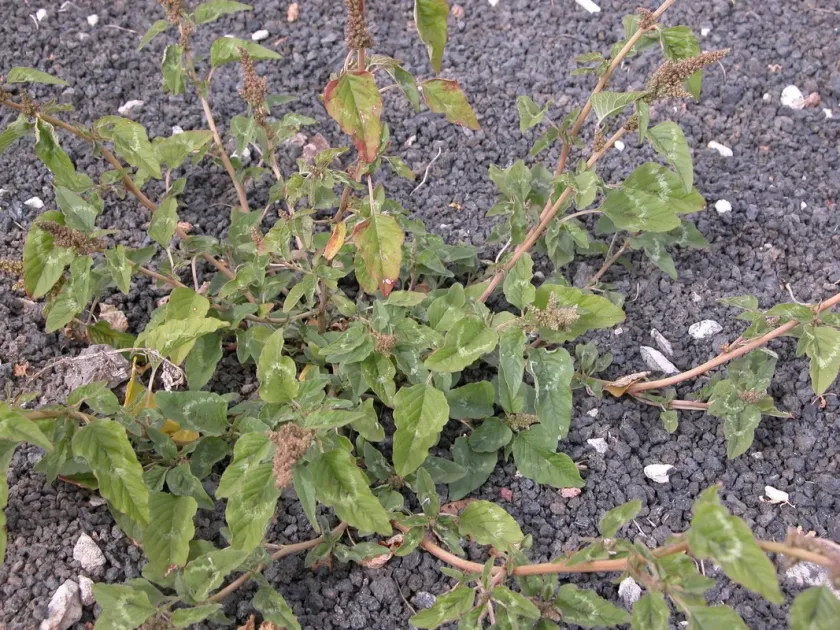
The plant features a branching stem that can be erect or prostrate. Its leaves are generally rhombic-ovate with a distinctive pointed apex, growing in an alternate arrangement.
Inflorescences typically form as dense clusters in the leaf axils or at the terminal parts of the branches, producing a large volume of small, dark seeds.
Its root system consists of a robust taproot, which allows the plant to efficiently extract nutrients and moisture from deeper soil layers compared to many competing species.
Botanically, it shares many structural characteristics with other pigweed species, making early identification critical for effective management in agricultural fields.
Where it grows
This weed is commonly found in disturbed soils, including agricultural fields, roadsides, and waste areas. It thrives in sunny locations with fertile soil conditions.
It is particularly problematic in row crops like corn, soybeans, and sunflowers, where it can quickly establish itself and compete for vital resources.
The species is highly heat-tolerant, meaning its germination peaks when soil temperatures are warm, often coinciding with the planting season of various summer crops.
Dispersal is primarily seed-driven, often facilitated by farm machinery, irrigation water, or contaminated seed stock transported between different field sections.
Due to its rapid growth rate, Standley's amaranth can quickly colonize patches within a field, especially in areas with high nitrogen levels or uneven crop stands.
Harm it causes
The primary harm caused by this plant is significant yield reduction due to aggressive competition for water, sunlight, and soil nutrients with the primary crop.
By rapidly overtopping crops during early growth stages, the weed creates dense shade that inhibits the photosynthesis and overall development of the crop.
Standley's amaranth serves as an alternative host for various crop pathogens and insects, increasing the overall disease and pest pressure on the farm.
The presence of this weed at harvest time often leads to increased moisture in the grain, mechanical blockages, and the need for extra post-harvest processing costs.
If left unmanaged, the high seed bank buildup ensures persistent issues for future seasons, making long-term control measures necessary to avoid economic losses.
How to control
Management of Standley's amaranth requires an integrated approach that utilizes both cultural practices and chemical control strategies to keep populations under control.
Effective cultural control includes proper crop rotation and the use of competitive crop varieties that can quickly establish a canopy and shade out the weed.
Mechanical cultivation remains a standard method for controlling young weed seedlings in row crops, provided the timing is correct before the plants become too established.
Chemical control involving pre-emergence and post-emergence herbicides is often necessary for larger infestations, strictly following the product's label requirements.
- Use of certified, clean seed to prevent new infestations.
- Timely inter-row cultivation to disturb weed root systems.
- Application of residual herbicides in the early season.
- Regular monitoring and spot-spraying of weed patches.
Taxonomy
- Latin name
- Amaranthus standleyanus
- Family
- Амарантовые
- EPPO code
- AMAST