
Mitchell's amaranth
Amaranthus mitchellii
Description
How to tell it apart
Mitchell's amaranth (Amaranthus mitchellii) belongs to the Amaranthaceae family. It is an annual herbaceous plant widely recognized for its robust growth habits.
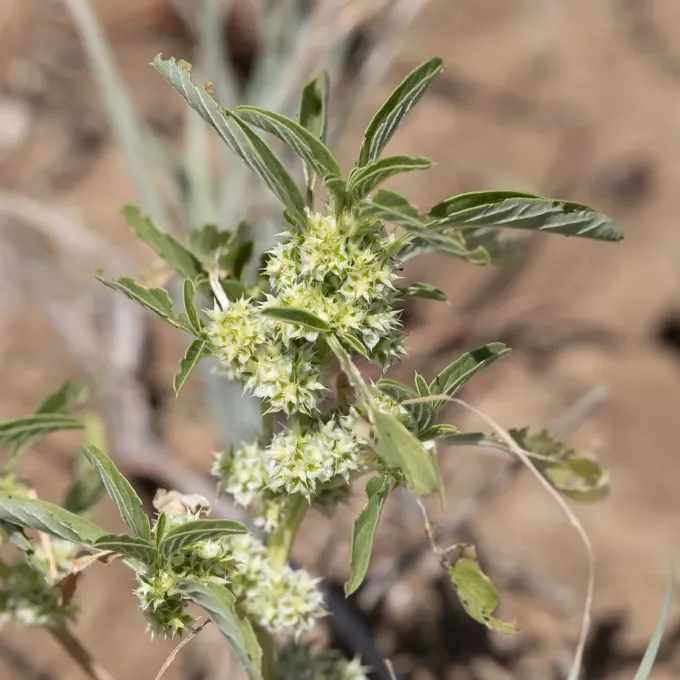
The stem can be erect or prostrate, typically growing to a height of 20 to 60 centimeters. Its leaves are rhomboid-ovate in shape, often featuring a distinct blunt tip.
Its inflorescences form dense, spike-like panicles found in leaf axils and at the stem apex. The flowers are small, greenish or whitish, and protected by sharp bracts.
The seeds are tiny, shiny, and dark-colored, enabling the plant to produce tens of thousands of seeds per individual, ensuring successful long-term soil persistence.
It possesses a deep taproot system, which allows it to thrive in arid conditions and compete effectively with crop plants for deep-soil water resources.
Where it grows
Native to Australia, Mitchell's amaranth is commonly found on disturbed lands, roadsides, and abandoned areas, often spreading into cultivated fields.
This weed prefers sunny locations with light, sandy, or loamy soils. It is highly heat-tolerant and can survive prolonged periods of drought.
It is a significant nuisance in row crops, particularly sorghum, corn, and cotton, where it can easily establish itself in the spaces between rows.
The plant readily colonizes field edges and irrigation channels, spreading seeds via wind, water movement, and agricultural machinery operations.
Its high adaptability allows it to complete its life cycle quickly, often maturing even under suboptimal environmental conditions.
Harm it causes
The primary damage is caused by the intense competition for soil moisture and nutrients, which can drastically reduce yields in sensitive crop species.
As it grows, Mitchell's amaranth creates significant shade for young seedlings, inhibiting their growth and resulting in uneven and stunted crop development.
It acts as a reservoir for various viral and fungal pathogens, potentially exposing crops to diseases that require costly chemical intervention to manage.
The biomass of this weed can severely interfere with harvesting operations, leading to equipment clogs and significantly higher losses during mechanical harvest.
Continuous presence of this weed in fields depletes the soil, making it harder for subsequent crops to establish themselves properly without added fertilization.
How to control
Effective control starts with proper tillage practices, such as deep plowing, which buries seeds deep enough to prevent germination during the next season.
Implementing crop rotation with dense-canopy crops is an essential cultural strategy to suppress the development of this weed through shading.
Inter-row cultivation is highly effective when performed early in the season, ensuring the weed is removed before it enters its flowering stage.
Chemical control usually involves the application of pre-emergence herbicides to limit initial germination and selective post-emergence herbicides for active growth.
- Sanitation of equipment to prevent the spread of seeds between fields.
- Timely herbicide application at the seedling stage (2-4 leaves).
- Combined use of mechanical and chemical methods for high-infestation areas.
Taxonomy
- Latin name
- Amaranthus mitchellii
- Family
- Амарантовые
- EPPO code
- AMAMI