
Amaranthus hybridus
Amaranthus hybridus
Description
How to tell it apart
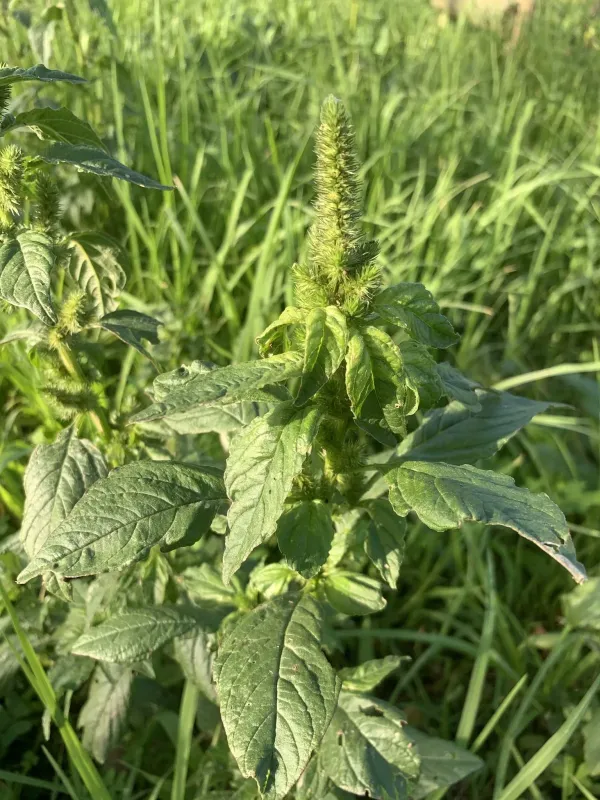
Amaranthus hybridus, commonly known as smooth pigweed, is an annual herbaceous plant belonging to the Amaranthaceae family. It is characterized by a strong taproot and a branched stem that can grow significantly in size depending on environmental conditions.
The leaves are diamond-shaped or ovate with pointed tips, attached to petioles. The foliage often appears slightly rough or smooth, with prominent veins that help distinguish it from other weed species in the same family.
Its inflorescences are dense, terminal or axillary panicles composed of many small flowers. The floral structure with five perianth segments is a key botanical trait used for the identification of this particular hybrid species.
The plant produces a vast number of small, glossy, black seeds contained within a capsule that dehisces at maturity. These seeds are known for their high longevity, remaining viable in the soil seed bank for many years.
As a highly adaptive plant, Amaranthus hybridus thrives in nutrient-rich soils and can rapidly produce vegetative biomass under favorable conditions of light and moisture.
Where it grows
This weed is a cosmopolitan species that frequently colonizes agricultural fields, gardens, and disturbed waste areas. It favors fertile, friable soils where it faces little competition during the initial growth stages.
It is particularly problematic in row crops like maize, soybeans, and sunflowers. Its ability to germinate over a long period makes it a persistent challenge for farmers throughout the entire growing season.
Harm it causes
The negative impact of Amaranthus hybridus stems from its aggressive resource consumption. It competes intensely with crops for sunlight, soil moisture, and essential nitrogen, often resulting in significant yield losses.
Because of its rapid vertical growth, the plant can overtop crop canopy, effectively shading out desirable plants and hindering their development during critical stages of growth and grain filling.
The sheer volume of seed production per individual plant ensures that the soil becomes heavily infested, necessitating long-term weed management programs to minimize the future seed bank density.
The weed serves as a host for various pests and diseases, such as viral pathogens or nematodes, which can easily spread to adjacent commercial crops, complicating integrated pest management efforts.
Furthermore, the presence of large stems at harvest time poses a physical obstacle for machinery, increasing harvest times and necessitating expensive post-harvest cleaning and seed separation processes.
How to control
Managing Amaranthus hybridus requires an integrated approach. Cultural practices such as crop rotation and timely soil cultivation are the first lines of defense against its rapid establishment.
Mechanical control, including inter-row cultivation in row crops, is highly effective if performed before the plants grow too large or begin to set seeds, as older plants are much more resilient.
Chemical control options include pre-emergence herbicides to prevent germination and post-emergence herbicides for active growth stages, though resistance must be carefully managed by rotating herbicide modes of action.
- Implementation of diverse crop rotation systems.
- Use of weed-free certified seeds for planting.
- Sanitation of field margins to prevent seed spread.
- Rotation of herbicide chemistry to combat resistance.
Consistent field scouting and prompt intervention are critical, as delaying control measures allows the weed to reach reproductive maturity, making it much harder to suppress in subsequent seasons.
Taxonomy
- Latin name
- Amaranthus hybridus
- Family
- Амарантовые
- EPPO code
- AMACH