
Spreading amaranth
Amaranthus deflexus
Description
How to tell it apart
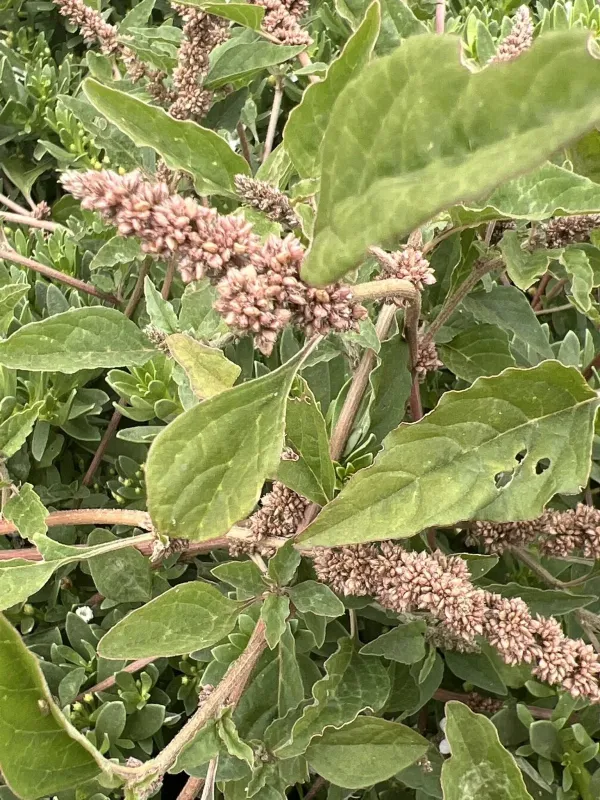
Spreading amaranth (Amaranthus deflexus) is an annual herbaceous plant belonging to the Amaranthaceae family. It is characterized by its prostrate or ascending stems that can reach lengths of up to 60 cm.
The leaves are typically rhombic or ovate in shape, often featuring a pointed tip and a petiole. The leaf surface is smooth or occasionally lightly pubescent, maintaining a green hue.
Its inflorescences are dense, spike-like thyrsi found at the ends of stems and in leaf axils. The flowers themselves are minute, inconspicuous, and greenish in color.
A key biological feature is the plant's massive seed production. The seeds are small, circular, and black, possessing a polished appearance and high germination potential.
The plant exhibits rapid growth, often spreading quickly across open or disturbed ground, which makes it a persistent presence in agricultural settings.
Where it grows
This weed thrives in loose, nitrogen-rich soils. It is commonly found in gardens, vegetable farms, along roadsides, and in abandoned or waste lands.
In field conditions, it poses a significant threat to row crops such as soybeans, corn, and various vegetables, where it competes for growing space.
It is a thermophilic plant, meaning it reaches peak development during the warm summer months when soil temperatures favor rapid germination and growth.
Spreading amaranth easily colonizes disturbed habitats, often exploiting the lack of cover in freshly cultivated or poorly managed agricultural fields.
Its high adaptability to varying moisture conditions allows it to establish itself in both irrigated and dryland farming systems.
Harm it causes
The primary damage caused by spreading amaranth is intense competition with crops for essential soil nutrients, moisture, and sunlight.
By developing a wide leaf canopy, the plant significantly shades seedlings, which suppresses their early growth and delays overall crop maturity.
The plant acts as a reservoir for various pests and pathogens, which can then migrate to and damage neighboring economically important crops.
Infestations of this weed interfere with mechanized harvesting operations and can contaminate crop yields with weed seeds, reducing market quality.
During drought conditions, the plant's root system extracts deep-soil moisture, exacerbating water stress for primary crops in the field.
How to control
Agronomic control relies on deep primary tillage, such as plowing, to bury seeds deep enough to prevent successful germination in subsequent seasons.
Integrated weed management includes timely mechanical cultivation between rows to eliminate young plants before they reach the flowering stage.
Chemical control utilizes selective pre-emergence or post-emergence herbicides, tailored to the specific crop being protected and the weed's development stage.
Sanitation of field borders and non-crop areas is critical to preventing the migration and future seeding of this plant into productive land.
- Routine weeding to remove plants before seed set.
- Application of herbicide programs compliant with crop safety standards.
- Strategic crop rotation to break the weed's life cycle.
Taxonomy
- Latin name
- Amaranthus deflexus
- Family
- Амарантовые
- EPPO code
- AMADE