
Purple amaranth
Amaranthus cruentus
Description
How to tell it apart
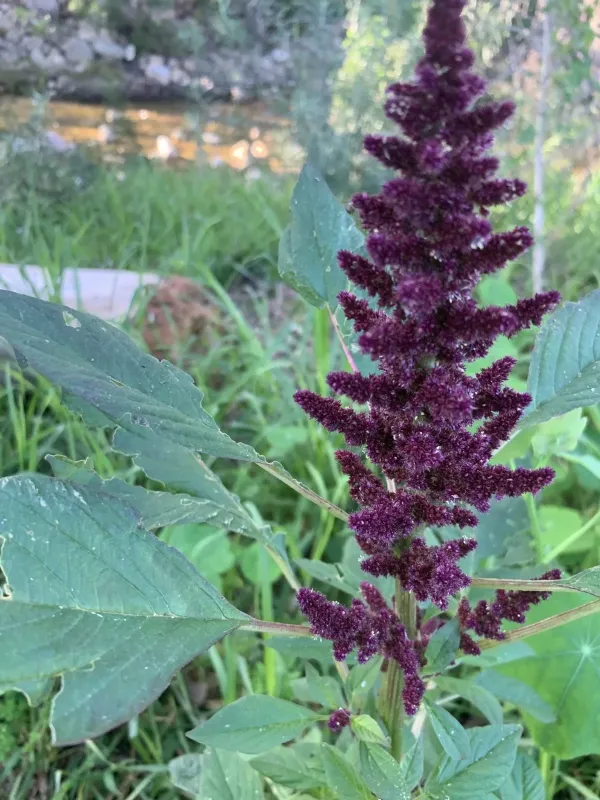
Purple amaranth, known scientifically as Amaranthus cruentus, belongs to the Amaranthaceae family. It is an annual herbaceous plant characterized by a sturdy, upright stem that can reach heights of up to 150 centimeters, often showing a reddish or purple hue.
The leaves are alternate, petiolate, and rhombic-ovate in shape with pointed tips. The plant's foliage is often pubescent and, depending on the environment and variety, can display vibrant shades of green or deep, dark purple.
It possesses a strong, branched taproot system that penetrates deeply into the soil. This structural advantage allows the plant to thrive in dry conditions where other weeds might struggle, making it a persistent competitor for water resources.
The flowers are arranged in dense, terminal or axillary panicles. These clusters are covered in small, spiky bracts, which not only protect the seeds but also make the plant tactilely rough and resistant to casual animal grazing.
Each plant produces a massive amount of small, dark seeds within dry capsules. These seeds are highly resilient and can remain viable in the soil for several years, ensuring that the plant returns season after season.
##habitat##This species is a warm-weather plant that favors nutrient-rich, fertile soils. It is particularly invasive in loose, well-drained loamy or sandy soils that receive adequate moisture during the early growing season.
Purple amaranth is a notorious weed in row crops, particularly in fields of corn, soybeans, sunflowers, and various vegetable crops. It thrives in open spaces between rows where sunlight is abundant and competition is initially low.
It is frequently found along field margins, roadsides, and abandoned lands. These peripheral areas act as reservoirs, allowing the weed to spread its seeds into adjacent cultivated fields via wind, water, or farm machinery.
Germination typically occurs once soil temperatures reach 10–12 degrees Celsius. Its rapid early growth gives it a competitive edge over many crops, allowing it to quickly establish dominance over the surrounding area.
Due to its high adaptability, the plant has successfully migrated across various climatic zones, becoming a significant problem for farmers in both temperate and subtropical agricultural regions globally.
##harm##The primary threat posed by Amaranthus cruentus is its aggressive nutrient and water uptake. By monopolizing these essential resources, the weed significantly stunts the growth of neighboring crops, leading to substantial yield losses.
The plant’s dense canopy shades the ground, preventing sunlight from reaching the lower leaves of crop plants. This reduction in light absorption impairs photosynthesis, causing delayed development and reduced harvest quality.
Purple amaranth acts as a biological host for various pests and plant diseases. Aphids and mites often congregate on its foliage, subsequently migrating to valuable crops and spreading viral infections that are difficult to manage.
Harvesting efficiency is severely hampered when fields are heavily infested. The fibrous stems can clog combine harvesters, leading to increased wear and tear on machinery and higher downtime for field crews.
Furthermore, because the plant is a prolific nitrate accumulator, grazing livestock that consume it in large quantities can suffer from nitrate poisoning, posing a significant risk to integrated crop-livestock systems.
##control##Cultural control is essential and begins with deep autumn plowing (tillage), which buries the weed seeds at depths where they cannot successfully germinate, effectively disrupting their life cycle before the next season.
Crop rotation is a powerful tool against this weed. By alternating with dense-growing crops or winter grains that shade the soil early, farmers can naturally suppress amaranth populations and prevent them from gaining a foothold.
Chemical intervention often involves the use of pre-emergent herbicides to stop germination. If the weed escapes early control, selective post-emergent herbicides should be applied while the plant is still in the juvenile stage (2–4 leaf phase).
Preventative maintenance is critical; this includes mowing or destroying weeds along field edges and cleaning machinery between fields to prevent the transport of seeds across the farm landscape.
- Implement diverse crop rotations.
- Perform timely mechanical inter-row cultivation.
- Use appropriate pre- and post-emergent herbicides.
- Maintain clean field borders to prevent seed spread.
Taxonomy
- Latin name
- Amaranthus cruentus
- Family
- Амарантовые
- EPPO code
- AMACR