
Tidal amaranth
Amaranthus cannabinus
Description
How to tell it apart
Tidal amaranth (Latin: Amaranthus cannabinus) belongs to the Amaranthaceae family. It is a robust annual herb that can grow to impressive heights, often towering over commercial crops in the field.
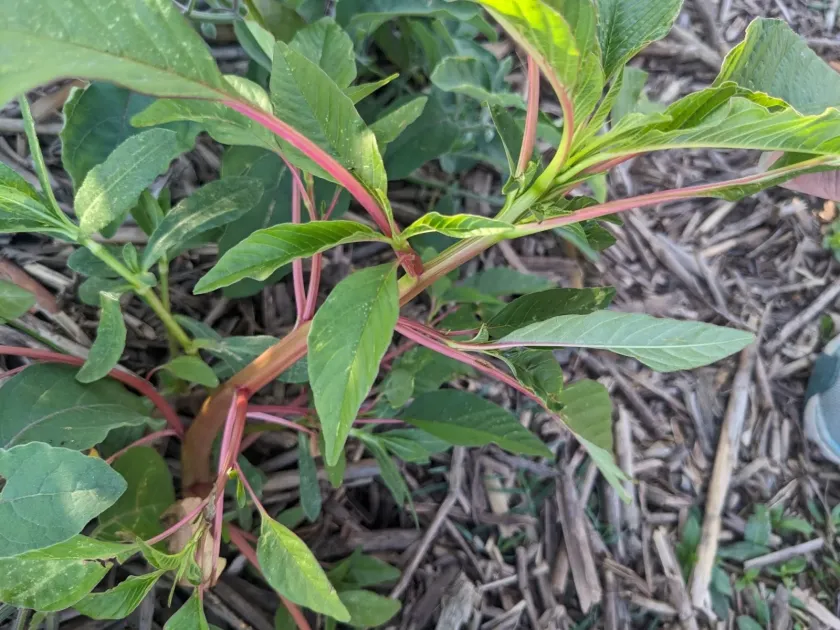
The stem is typically erect and branching, sometimes displaying a reddish coloration. Its leaves are lanceolate or narrow-ovate in shape, resembling hemp leaves, which gives the plant its unique name.
The inflorescences are dense, panicle-like clusters located in leaf axils or at the tips of shoots. The flowers themselves are extremely small, greenish or yellowish, and are packed tightly into glomerules.
It possesses a strong, deep taproot system, which provides the plant with exceptional drought resistance and the ability to anchor firmly in various soil types, including riparian areas.
The seeds are tiny, shiny, and dark brown or black. A single mature plant can produce hundreds of thousands of seeds, allowing it to persist in the soil seed bank for many years.
Where it grows
This weed prefers moist environments and is commonly found in floodplains, along riverbanks, and in wetlands. It often thrives in agricultural fields with poor drainage or high moisture levels.
It is particularly problematic in row crops such as corn, soybeans, and sunflowers. It frequently colonizes areas where the soil water regime is unbalanced or has been disturbed by human activity.
Tidal amaranth is a typical ruderal species, meaning it is among the first to colonize disturbed land, including ditches, irrigation canals, field margins, and waste grounds near storage areas.
The species thrives in nitrogen-rich soils, often appearing in areas affected by manure application or run-off, making it a persistent nuisance in productive agricultural regions.
Possessing high environmental plasticity, this weed adapts quickly to shifting conditions, enabling it to outcompete native vegetation and quickly occupy newly available ecological niches.
Harm it causes
The primary damage caused by tidal amaranth is its massive demand for soil moisture and nutrients. It effectively strips the soil of resources, limiting the growth potential of neighboring crops.
Its tall stature causes significant shading, which inhibits photosynthesis in crop plants. This leads to stunted growth, reduced leaf area, and ultimately a significant decline in harvestable yield.
The accumulation of its seeds in the soil creates a long-lasting weed bank that is notoriously difficult to eradicate, requiring multi-year management strategies to suppress future generations.
Tidal amaranth acts as an alternative host for various crop pathogens and pests. By providing a habitat for these organisms, it increases the risk of infestation in commercial crops, leading to increased pesticide use.
During harvesting, the presence of weed biomass in the field can impede mechanical equipment, while weed seeds may contaminate the crop grain, reducing its quality and lowering its market value.
How to control
Cultural control is essential and involves strict adherence to crop rotation to break the weed's life cycle. Deep plowing is often used to bury seeds to a depth that prevents germination.
Mechanical cultivation between rows is highly effective if performed during the early seedling stage. It is crucial to intervene before the plant develops reproductive structures to prevent further seed shedding.
Chemical control relies on pre-emergence soil herbicides to block germination and selective post-emergence herbicides to target the weed while sparing the crop. Early application is key to success.
Managing non-crop areas, such as field boundaries and irrigation ditches, is vital to prevent seed dispersal onto primary cultivated plots. Integrated weed management programs are the most reliable approach.
- Timely herbicide application during the 2-4 leaf stage.
- Mowing non-crop areas before the flowering period.
- Using certified weed-free seed for planting to prevent spread.
Taxonomy
- Latin name
- Amaranthus cannabinus
- Family
- Амарантовые
- EPPO code
- ACGCA