
Alternanthera sessilis
Alternanthera sessilis
Description
How to tell it apart
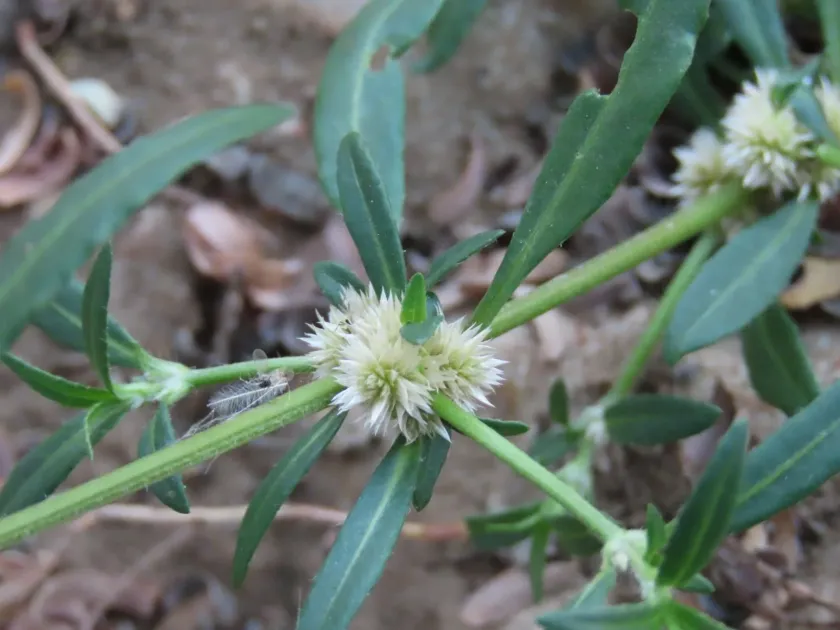
Alternanthera sessilis, commonly known as sessile joyweed, is a perennial herb belonging to the Amaranthaceae family. It is recognized for its adaptive nature, capable of growing in both terrestrial and semi-aquatic environments.
The plant features prostrate or ascending stems that often root at the nodes when in contact with moist soil. The leaves are opposite, ranging from elliptical to lanceolate in shape, with entire margins.
Its flowers are small, white, or silvery, arranged in axillary sessile clusters. The lack of pedicels gives the inflorescence its characteristic appearance, distinguishing it from other Alternanthera species.
The root system is fibrous and robust, allowing the plant to persist even after mechanical attempts to eradicate the above-ground biomass.
Reproduction occurs via both seeds and vegetative fragments. Even small segments of the stem, if left in moist conditions, can successfully establish new populations.
Where it grows
This weed thrives in moist to wet habitats. It is commonly found along riverbanks, irrigation ditches, canals, and especially in rice paddies where moisture levels remain high.
In tropical and subtropical regions, it is considered a problematic weed in rice cultivation, competing aggressively with the crop during its early development stages.
It adapts well to various soil types, preferring fertile and damp substrates. It is also frequently observed in disturbed areas and pastures with high water tables.
The spread of the plant is often exacerbated by agricultural practices, where machinery and irrigation water serve as vectors for seed and vegetative piece dispersal across fields.
Its presence in irrigation networks is a common issue, as the plant can obstruct water flow and serve as a reservoir for further dispersal into adjacent cultivated lands.
Harm it causes
The primary damage caused by Alternanthera sessilis is its ability to create dense ground cover, which severely outcompetes crops for light, water, and essential nutrients.
In rice fields, the presence of this weed leads to significant nutrient depletion, resulting in reduced crop vigor, lower yields, and a decline in grain quality at harvest.
It serves as an alternative host for various agricultural pests and pathogens, increasing the risk of secondary infections and pest outbreaks within the primary crop.
Infestation of irrigation channels reduces water flow efficiency, increasing operational costs for farmers who must perform regular clearing of drainage and supply systems.
Due to its high resilience and vegetative regeneration capacity, it is difficult to eradicate, leading to long-term economic losses if not managed during the early stages.
How to control
Agrotechnical management includes deep plowing and regular cleaning of irrigation structures to reduce the weed's seed bank and prevent further vegetative spread.
Proper water management in rice paddies is crucial, as the timing and depth of flooding can be manipulated to create conditions unfavorable for the growth of this weed.
Chemical control is most effective using systemic herbicides. Selecting herbicides that provide selective control while sparing the rice crop is essential for successful weed management.
Timely application during the early growth stages is highly recommended to maximize effectiveness and minimize the impact on crop yields.
- Implement diverse crop rotations to disrupt the weed's life cycle.
- Monitor field edges and irrigation channels for early signs of invasion.
- Utilize high-quality, weed-free seeds to prevent the introduction of the plant.
Taxonomy
- Latin name
- Alternanthera sessilis
- Family
- Амарантовые
- EPPO code
- ALRSE