
Alternanthera paronychioides
Alternanthera paronychioides
Description
How to tell it apart
Alternanthera paronychioides belongs to the Amaranthaceae family. It is a perennial herbaceous plant that typically exhibits a prostrate or creeping growth habit.
The stems are branched and possess the ability to root at the nodes, allowing the plant to spread rapidly across the soil surface and form dense mats.
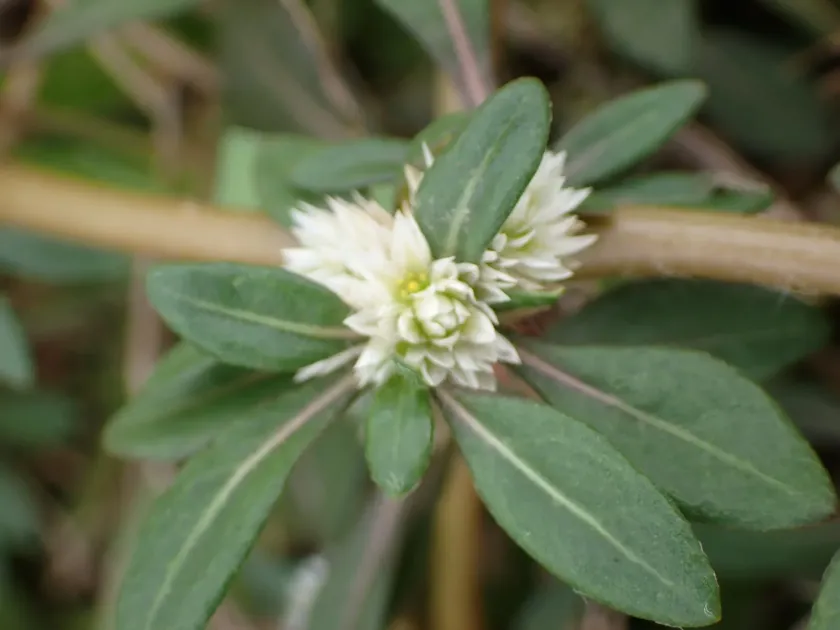
Leaves are generally oblong or spatulate, arranged oppositely along the stems, and have a distinct texture characteristic of the species.
The inflorescences are small, dense, head-like clusters located in the leaf axils, surrounded by white, papery bracts which are key identifying features.
The species reproduces effectively through both seeds and vegetative fragments, making it a highly resilient and difficult-to-control weed in agricultural fields.
Where it grows
This weed thrives in moist, disturbed environments and is commonly found near water bodies, drainage canals, and low-lying, poorly drained fields.
It is particularly problematic in irrigated agriculture, including rice paddies and vegetable crops where high soil moisture is constantly maintained.
The plant frequently colonizes road verges and field margins, serving as a source for further spread into cultivated areas via machinery and irrigation water.
It is highly adaptable to various soil types and can establish itself in orchards and vineyards, often competing with young seedlings for nutrients.
Due to its creeping nature, it can rapidly cover large areas of fallow land, making soil preparation more difficult in subsequent cropping seasons.
Harm it causes
The primary economic harm is caused by intense competition for nutrients, water, and sunlight, which significantly stunts the growth of primary crops.
Massive infestations create a dense ground cover that prevents proper aeration of the soil and hinders the root development of cultivated plants.
The weed interferes with agricultural operations, such as mechanical weeding and harvesting, often clogging machinery and increasing maintenance costs.
It acts as an alternative host for various plant pathogens and insect pests, facilitating their survival and spread throughout the growing season.
Infestation leads to reduced quality and quantity of crop yields, ultimately resulting in significant financial losses for the grower.
How to control
Integrated weed management is essential; cultural practices such as deep plowing help in burying vegetative parts to prevent rooting and regrowth.
Crop rotation remains a fundamental strategy, alternating heavy-feeding crops with those that can shade out the weed and disrupt its life cycle.
Mechanical cultivation between rows must be conducted frequently and accurately to sever runners before they gain a strong foothold in the soil.
Chemical control involves the use of selective, systemic herbicides applied during the early growth stages to ensure maximum translocation and efficacy.
- Application of pre-emergent herbicides to prevent seedling establishment.
- Post-emergent herbicide spraying during the active growth phase.
- Cleaning equipment to prevent transport of vegetative segments.
- Manual removal in high-density areas or small organic plots.
Taxonomy
- Latin name
- Alternanthera paronychioides
- Family
- Амарантовые
- EPPO code
- ALRPA