
Alternanthera nodiflora
Alternanthera nodiflora
Description
How to tell it apart
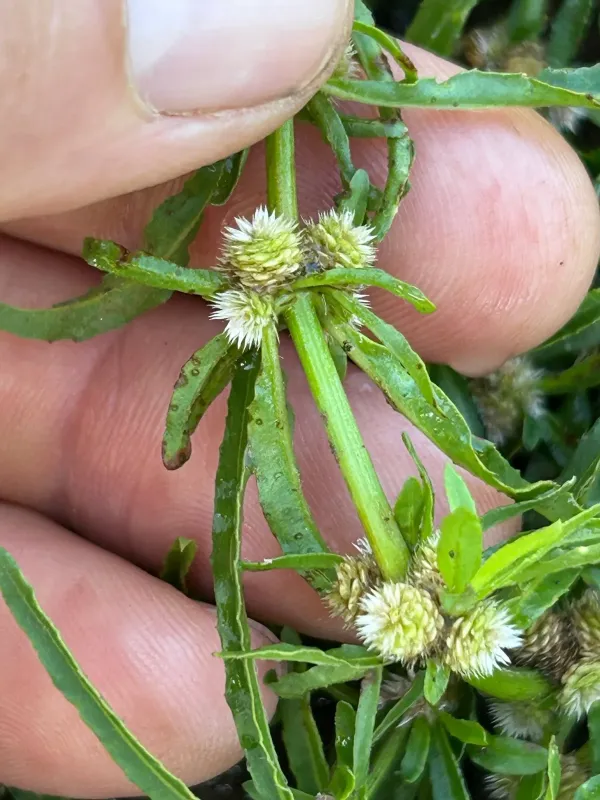
Alternanthera nodiflora is a member of the Amaranthaceae family. It is a perennial or annual herb with stems that can be either prostrate or ascending in habit.
The leaves are opposite, usually lanceolate to linear-lanceolate, with entire margins. The stems can grow up to 60 cm in length and are often branched from the base.
The inflorescences are dense, spherical to oblong heads located in the leaf axils or at the tips of the stems, from which the name of the species is derived.
The flowers are small and surrounded by silvery-white bracts, which give the flower heads a distinctive appearance in the field.
The plant exhibits high morphological plasticity, allowing it to adapt to various moisture levels, though it clearly favors wetland environments.
Where it grows
This species is a typical hydrophyte, preferring wet, marshy, or aquatic environments. It is commonly found in tropical and subtropical regions worldwide.
It frequently colonizes rice paddies, irrigation channels, and the edges of drainage systems, thriving where there is standing or slow-moving water.
Alternanthera nodiflora spreads through seed dispersal by water and through vegetative fragmentation, where pieces of stems can easily root in saturated soil.
The plant is highly resilient and can withstand temporary soil drying, which allows it to persist even in fields that undergo periodic water management cycles.
Its ability to invade disturbed wet areas makes it a persistent weed in agricultural irrigation networks and flood-irrigated farmland.
Harm it causes
The primary damage caused by Alternanthera nodiflora is its aggressive competition with crops, particularly rice, for essential resources like nutrients and sunlight.
By forming dense mats of vegetation, it suppresses the initial growth of crops, leading to significant yield reductions and lack of uniformity in field emergence.
In irrigation systems, this weed acts as an obstruction, blocking water flow and increasing the rate of siltation, which disrupts proper field irrigation schedules.
The weed hampers mechanical field operations, as its tangled growth can interfere with farm machinery, including harvesters and cultivators.
It also acts as an alternative host for various pests and pathogens, increasing the overall phytosanitary risk to the main crop cultivated in the area.
How to control
Effective control involves precise land leveling and water management to ensure uniform flooding, which can suppress the weed in the early stages of rice development.
A sound crop rotation strategy, alternating flooded rice with dry-land crops, is highly effective in disrupting the life cycle of this aquatic weed.
Physical measures include the maintenance of irrigation channels by regular cleaning and the manual removal of weed hotspots to prevent seed bank build-up.
Chemical control focuses on the use of selective herbicides applied during the early vegetative stage of the crop to minimize competition during the critical period.
- Regular mowing of canal banks and drainage ditches.
- Application of systemic herbicides registered for aquatic/rice use.
- Strict regulation of water depth to prevent weed establishment.
- Integrated weed management focusing on early prevention.
Taxonomy
- Latin name
- Alternanthera nodiflora
- Family
- Амарантовые
- EPPO code
- ALRNO