
Dwarf Alternanthera
Alternanthera nana
Description
How to tell it apart
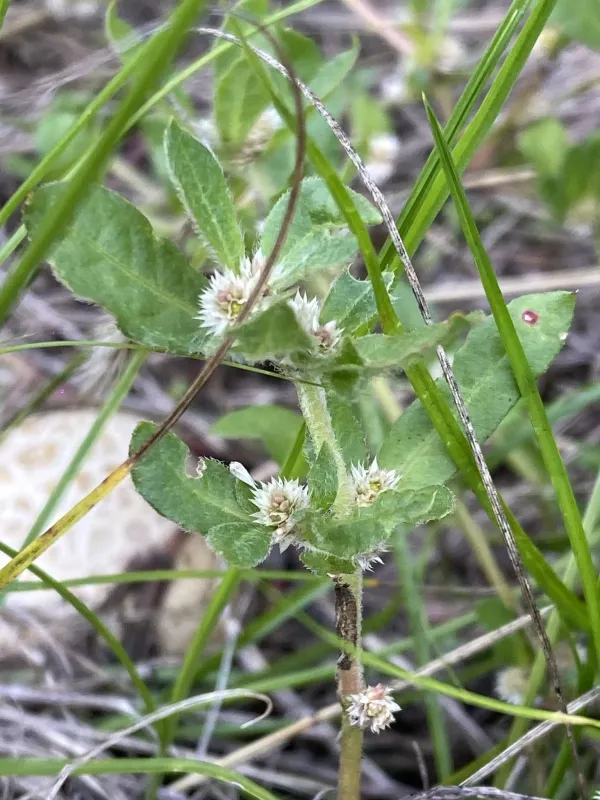
Dwarf Alternanthera (Alternanthera nana) belongs to the Amaranthaceae family. It is a perennial herbaceous plant that often takes on a prostrate or cushion-like growth habit.
The stems of the plant are typically branched and can be either glabrous or pubescent. The leaves are oblong or linear-lanceolate in shape and are arranged in an opposite pattern along the stem.
Inflorescences appear as dense heads or spike-like formations located in the leaf axils or at the tips of the shoots. The flowers are small, surrounded by bracts, and are usually white or silvery in color.
The root system is sufficiently developed to anchor the plant in various soil types, ensuring high survival rates in arid conditions. Propagation occurs both by seeds and vegetatively through the rooting of stem nodes.
A distinctive feature is the plant's ability to quickly adapt to changing light and moisture conditions, which makes it an aggressive competitor in natural plant communities.
Where it grows
The species is native to Australia, where it is widely distributed in the northern and central regions of the country. It is found primarily in open grassland communities, savannas, and grazing lands.
The plant prefers well-drained sandy or loamy soils, often colonizing roadsides, disturbed land, and areas with minimal vegetation cover.
In agricultural practice, Dwarf Alternanthera can infest grain crops, vegetable plantations, and irrigated fields where it takes advantage of available water resources.
High competitiveness is observed in pastures, where the weed can displace forage grasses, significantly reducing the productivity for livestock.
Seed dispersal is facilitated by wind, water runoff, and agricultural machinery, which transports stem fragments to new areas of the field.
Harm it causes
The primary damage lies in intense competition with crops for living space, moisture, and soil nutrients, especially during the early stages of the growing season.
In grazing areas, Alternanthera can reduce the overall nutritional value of the pasture. When it grows in dense masses, it prevents the normal development of valuable forage grasses.
The weed acts as a reservoir for various viral and fungal diseases that can subsequently be transmitted by insect pests to cultivated crops.
Infestation of fields with this species significantly complicates mechanical operations such as sowing and harvesting, and increases the costs associated with post-harvest grain cleaning.
Dense thickets created by the plant provide favorable conditions for the breeding of pests, which later attack crops, ultimately reducing both the quality and quantity of the yield.
How to control
The foundation of control is the adherence to a crop rotation system that includes competitive crops capable of suppressing weed development through rapid canopy closure.
Mechanical soil cultivation, including deep plowing and systematic harrowing, effectively destroys the root system and young weed seedlings at the beginning of the growing season.
- Utilizing crop rotations with competitive plant species.
- Timely inter-row cultivation.
- Application of broad-spectrum herbicides during the active growth phase.
- Restricting livestock grazing in heavily infested areas.
Chemical control is carried out through the application of systemic herbicides effective against dicotyledonous weeds, targeted at the growth stages when the plant is most vulnerable to active ingredients.
Prevention is a key aspect: cleaning agricultural machinery before moving from infested fields to clean areas and ensuring the cleanliness of seed materials.
Taxonomy
- Latin name
- Alternanthera nana
- Family
- Амарантовые
- EPPO code
- ALRNA