
Alternanthera flavescens
Alternanthera flavescens
Description
How to tell it apart
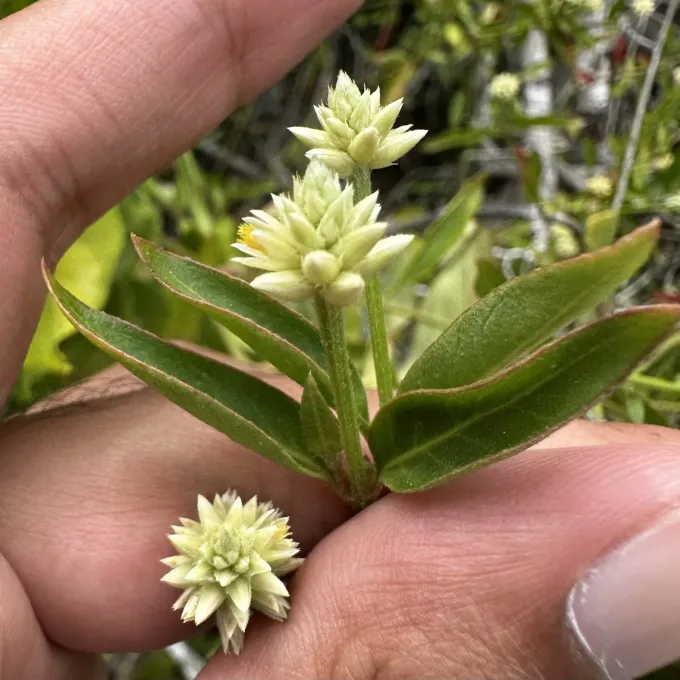
Alternanthera flavescens belongs to the Amaranthaceae family. It is a herbaceous plant that often exhibits prostrate or ascending growth habits, forming dense mats.
The stems are branched, often displaying greenish-yellow or reddish hues. Leaves are arranged oppositely, typically lanceolate or elliptical in shape with entire margins.
Flowers are gathered in capitate or spike-like inflorescences located in leaf axils or at stem tips. The perianth consists of scarious, white or yellowish bracts.
The plant possesses a fibrous root system that penetrates deep into the soil, providing the weed with excellent resilience under varying environmental conditions.
It propagates through seeds easily dispersed by wind, water, and machinery, and also vegetatively, as stems can readily root at the nodes when disturbed.
Where it grows
This species prefers open, well-lit environments. It is frequently found in moist soils, along water bodies, irrigation channels, and low-lying areas.
In agricultural settings, Alternanthera flavescens poses a significant threat to row crops, particularly in regions with tropical or subtropical climates.
It is especially problematic in paddy fields, vegetable plantations, and perennial orchards where high moisture content facilitates its rapid expansion.
The weed colonizes fallow areas quickly after soil tillage, leveraging its high growth rate and ability to produce substantial biomass in a short period.
It is commonly found as a ruderal species along roadsides and abandoned fields, which serves as a primary source for secondary infestation of crop fields.
Harm it causes
The primary damage caused by this weed is intense competition with crops for essential resources including water, sunlight, and soil minerals.
Through vigorous vegetative growth, the plant quickly closes canopy gaps, suppressing young crop seedlings and leading to significant yield losses and reduced crop quality.
The weed creates microclimates that favor the development of various pathogens and pests, acting as a reservoir for diseases that subsequently spread to crops.
The presence of this weed complicates mechanized harvesting operations by clogging equipment components, thereby increasing downtime and maintenance costs.
In irrigated farming, the plant can clog irrigation infrastructure, reducing water flow efficiency and contributing to the silting of canals.
How to control
Effective management requires an integrated approach combining agronomic practices with targeted chemical applications during critical growth stages.
The cornerstone of agronomic control is deep autumn plowing, which helps to sever roots and bury seeds deep enough to prevent successful germination.
Frequent inter-row cultivation and timely mechanical weeding in row crops are essential for keeping population numbers below economic thresholds.
Chemical control involves the use of selective systemic herbicides that effectively translocate to inhibit both the foliage and the root system of the weed.
- Timely mowing before the onset of flowering.
- Implementation of crop rotations that shade out weed development.
- Rigorous monitoring and use of weed-free seeds.
Taxonomy
- Latin name
- Alternanthera flavescens
- Family
- Амарантовые
- EPPO code
- ALRFL