
Alternanthera ficoidea
Alternanthera ficoidea
Description
How to tell it apart
Alternanthera ficoidea is a member of the Amaranthaceae family, commonly recognized as a perennial herbaceous plant with a prostrate or ascending growth habit.
The plant is characterized by its stems, which often root at the nodes, allowing the weed to form dense mats across the soil surface quite rapidly.
Its leaves are opposite, varying in color from green to vibrant shades of red and purple, which is one of the most distinctive features for identification in the field.
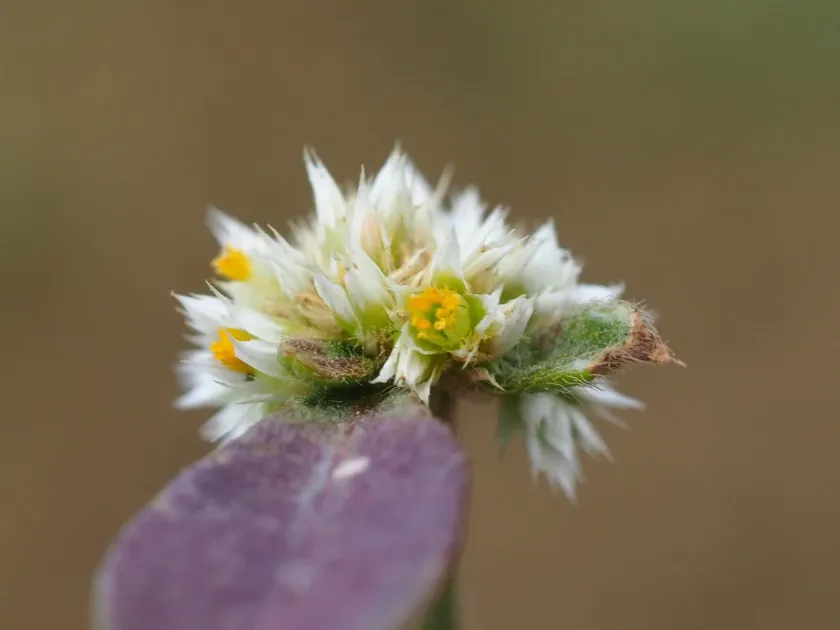
Flowers are small, inconspicuous, and organized into dense, globose heads that appear in leaf axils or at the terminal points of the stems.
It is classified as a persistent perennial weed that thrives due to its strong ability to propagate both vegetatively and through seed dispersal mechanisms.
Where it grows
This species naturally inhabits tropical and subtropical regions, favoring moist soil environments such as riverbanks, wetlands, and irrigated agricultural lands.
In farming systems, it is a significant nuisance in areas with high water availability, including vegetable fields, soybean plots, and corn cultivation.
It often invades disturbed areas where the lack of competitive ground cover allows it to establish dominance quickly in nitrogen-rich soils.
Human activity, including the movement of irrigation water and the use of infested machinery, is the primary vector for spreading this weed into new fields.
The plant shows high tolerance for various light conditions, from full sun to partial shade, making it a versatile and difficult-to-eradicate invader.
Harm it causes
Alternanthera ficoidea causes significant economic loss by competing with staple crops for essential soil nutrients, moisture, and sunlight during the growing season.
The dense foliage creates a canopy that suppresses the growth of young crop seedlings, leading to reduced plant density and uneven maturation in the field.
By clogging irrigation canals and water channels, the weed disrupts water management, causing inefficient resource use and potential drainage problems.
It acts as a host for various agricultural pests and viral diseases that can migrate to cash crops, thereby increasing the costs of integrated pest management.
Harvesting efficiency is severely hindered by the thick, tangled stems of the weed, which cause equipment downtime and damage to combine harvester components.
How to control
Effective agrotechnical control requires deep tillage and mechanical destruction of the root system to prevent the plant from re-establishing itself from fragments.
Integrating diverse crop rotations helps to disrupt the weed's life cycle and provides better competition against its rapid colonization patterns.
Regular cultivation of inter-row spaces is crucial during the early stages of crop development to minimize the impact of the weed on total yield.
Chemical control involving systemic herbicides is often necessary in heavy infestations, though success depends on proper application timing and environmental conditions.
Strict hygiene measures, including the cleaning of field equipment and managing water run-off from infested areas, are essential to stop the spread of the species.
Taxonomy
- Latin name
- Alternanthera ficoidea
- Family
- Амарантовые
- EPPO code
- ALRFI