
Lesser joyweed
Alternanthera denticulata
Description
How to tell it apart
Lesser joyweed (Alternanthera denticulata) is a perennial herbaceous plant belonging to the Amaranthaceae family. It is characterized by its prostrate or ascending stems that often root at the nodes.
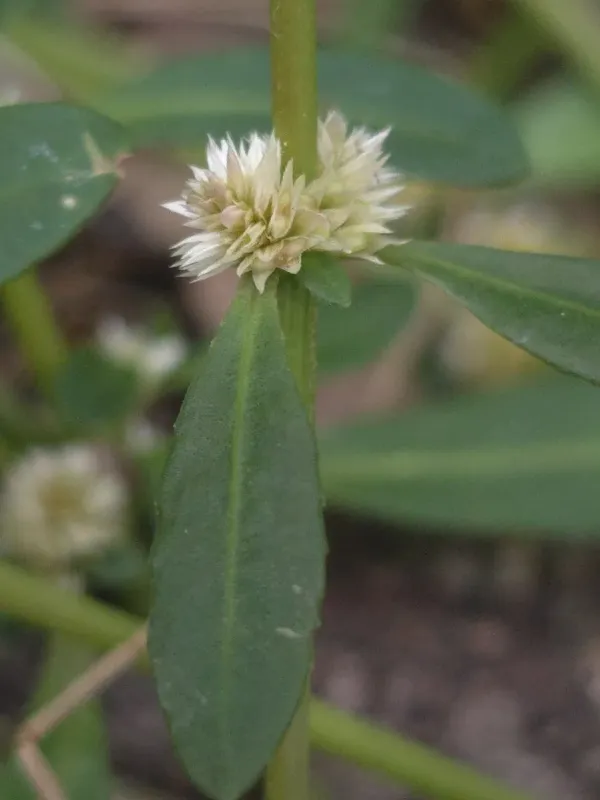
The leaves are typically lanceolate to elliptical in shape and arranged in opposite pairs along the stem, with distinct small teeth along the leaf margins.
The flowers are small, white, or cream-colored, forming dense, spherical-shaped clusters located in the leaf axils on short stalks, making them easily identifiable.
It possesses a creeping, well-developed root system that enables the plant to spread rapidly through vegetative growth, forming thick mats across the soil surface.
The plant demonstrates high adaptability to various environments, allowing it to regenerate effectively even after being disturbed by mechanical cultivation efforts.
Where it grows
This weed is primarily found in damp habitats, such as along the edges of waterways, riverbanks, and in irrigated agricultural fields where moisture is abundant.
In farming systems, it is a significant concern in rice paddies, vegetable crops under irrigation, and plantations situated in tropical and subtropical regions.
It thrives in loose, fertile soils with high water tables, where it can aggressively compete for light and nutrients with the primary cultivated crops.
It often establishes itself in drainage systems and irrigation canals, eventually spreading to the cultivated land through water distribution networks.
Lesser joyweed also colonizes fallow areas and field boundaries, serving as a reservoir for further infestation of the adjacent active agricultural plots.
Harm it causes
The primary damage caused by lesser joyweed is its intense competition for limited resources such as soil moisture, sunlight, and applied fertilizers, leading to reduced crop yields.
Due to its vegetative propagation mechanism, improper mechanical weeding often leads to further spreading, as stem fragments can easily re-root and establish new colonies.
Its ability to form dense mats complicates harvesting processes and lowers the overall market value of the crop due to contamination and competition.
The weed serves as a secondary host for various agricultural pests and diseases, increasing the overall phytosanitary risks within the cropping system.
Infestation of irrigation and drainage infrastructure causes siltation and reduced water flow, requiring expensive maintenance and remedial efforts for the farmer.
How to control
Mechanical control methods involve regular deep tillage to destroy the root system and inhibit the ability of the plant to re-root from stem fragments.
Managing the cleanliness of irrigation channels and water sources is vital to prevent the spread of the weed onto agricultural lands via irrigation water.
Implementing effective crop rotation strategies that involve dense-canopy crops can suppress the development of lesser joyweed by limiting its light availability.
Chemical control usually requires systemic herbicides that can effectively penetrate the vascular system of the weed, reaching the roots for complete elimination.
Integrated weed management, combining cultural practices with appropriate herbicide application, is the most effective approach for long-term control of this species.
Taxonomy
- Latin name
- Alternanthera denticulata
- Family
- Амарантовые
- EPPO code
- ALRDE