
Brazilian joyweed
Alternanthera brasiliana
Description
How to tell it apart
Alternanthera brasiliana belongs to the Amaranthaceae family. It is a perennial herbaceous plant with stems that can be erect or ascending and often root at the nodes when in contact with moist soil.
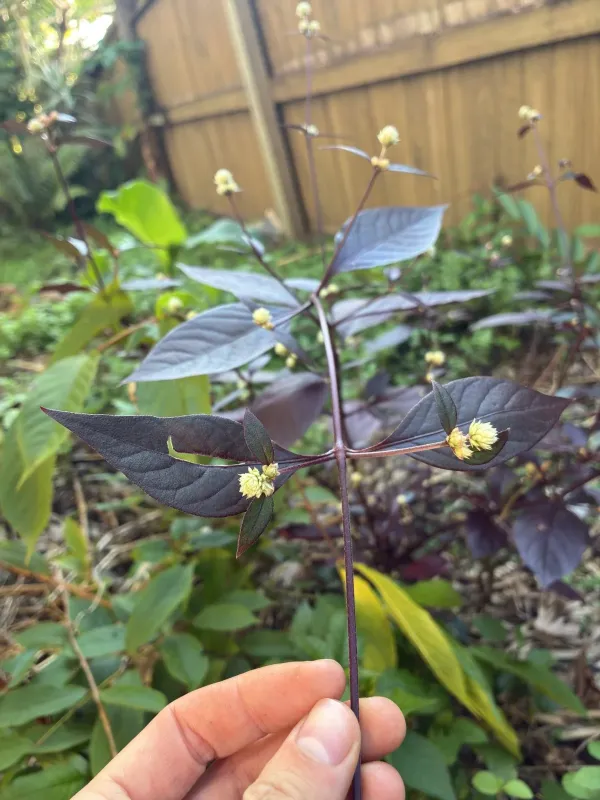
The leaves are opposite, ranging in shape from elliptical to lanceolate. Depending on light exposure, the foliage may develop a distinct reddish or purple hue, serving as a reliable identification marker.
The inflorescences are dense, head-like clusters found in leaf axils or at the tips of branches. Small flowers are surrounded by bracts, which can give the cluster a prickly appearance as it matures.
A robust and branched root system allows the plant to access deep soil moisture, contributing to its high resilience and survival during periods of environmental stress.
Propagation occurs via seeds and vegetative fragments; even small pieces of stem left after cultivation can generate new growth, making it a persistent weed.
Where it grows
Native to tropical and subtropical South America, particularly Brazil, this species thrives in environments with consistent moisture and high light availability.
In agricultural settings, it is commonly found in row crops, plantations, gardens, and along irrigation ditches where disturbed soil allows it to colonize rapidly.
The plant exhibits high ecological plasticity, enabling it to inhabit both fertile cultivated lands and degraded areas where natural vegetation has been removed.
It poses a significant challenge in open field conditions where rapid canopy development can outcompete and shade out emerging commercial crops.
The species is also distributed through horticultural trade, often escaping from ornamental gardens into wild or agricultural zones, becoming a troublesome weed.
Harm it causes
The primary damage results from intense competition for water, nutrients, and space, which significantly impacts the yield and quality of primary crops.
Its fast growth rate allows the weed to quickly establish dominance in fields, suppressing the development of crops during their most vulnerable seedling stage.
By consuming substantial amounts of soil moisture, the plant creates severe water stress for adjacent crops, especially in regions with irregular rainfall patterns.
The plant acts as an alternative host for various viral and fungal pathogens, which can then spread to cultivated crops and lead to widespread infections.
Presence of this weed increases harvesting costs and complicates post-harvest processing by contaminating the final product with plant debris.
How to control
Agronomic control strategies prioritize deep plowing to expose and desiccate the root systems, effectively preventing vegetative regrowth from stem fragments.
Implementing a crop rotation scheme that utilizes species with dense foliage is an effective way to shade out the weed and limit its ability to photosynthesize.
- Manual removal of plants before they reach the flowering stage.
- Applying organic or synthetic mulch to suppress seedling germination.
- Maintaining field boundaries and ditches to prevent the spread of infestations.
Chemical control involves the use of systemic herbicides that can move through the plant tissue to reach and kill the root system of the perennial weed.
Applications should target the period of active vegetative growth to ensure optimal translocation of active ingredients throughout the plant structure.
Taxonomy
- Latin name
- Alternanthera brasiliana
- Family
- Амарантовые
- EPPO code
- ALRBR