
Allenrolfea occidentalis
Allenrolfea occidentalis
Description
How to tell it apart
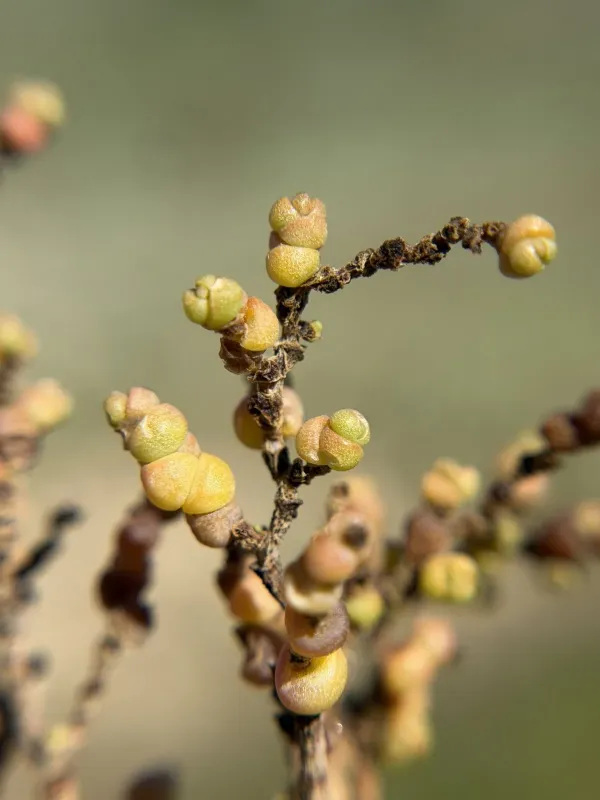
Allenrolfea occidentalis, commonly known as iodine bush, is a perennial subshrub belonging to the Amaranthaceae family. Its structure is unique, characterized by succulent, fleshy, and jointed stems that appear almost leafless.
The plant grows up to one meter in height, forming dense, shrubby patches in saline environments. Its stems are glaucous or green and can turn reddish-brown during different stages of development.
Flowers are tiny and produced in dense, spike-like inflorescences at the tips of the branches. The plant reproduces through small seeds which are easily dispersed by wind and water across saline landscapes.
It possesses an extensive and deep root system that allows it to thrive in extremely dry and high-salinity conditions where common vegetation cannot survive.
As a true halophyte, its biological mechanisms are adapted to tolerate high levels of salts in soil moisture, making it a highly persistent species in specific habitats.
Where it grows
This species is primarily native to arid regions of North and South America. It is commonly found in deserts, semi-arid plains, and around the fringes of salt lakes and salt pans.
In an agricultural context, Allenrolfea occidentalis often colonizes irrigated lands that suffer from secondary salinization. It thrives in areas where poor drainage leads to high salt accumulation.
It prefers heavy, saline soils and can be found in lowland areas where mineralized groundwater reaches the upper layers of the soil profile.
The plant frequently invades disturbed landscapes where soil structure has been negatively impacted by excessive irrigation and lack of proper land management.
It serves as a botanical indicator of severe soil salinity, marking areas that require significant remediation efforts before intensive farming can be productive.
Harm it causes
Allenrolfea occidentalis is a potent competitor for water and nutrients in saline fields. By dominating the landscape, it suppresses the growth of desirable agricultural crops.
The dense, woody stems of mature plants obstruct mechanical field operations, causing damage to tractors and harvesting machinery, thus increasing farming costs.
It can harbor insect pests and pathogens that may migrate to nearby crops, worsening the overall phytosanitary health of the farmland.
In grazing lands, this weed is undesirable because it accumulates salts in its tissues, making it unpalatable and often toxic for livestock to ingest in large quantities.
Its presence indicates and maintains high salt levels in the root zone, hindering the natural leaching process and degrading the overall quality of the soil.
How to control
The most effective long-term control strategy is improving soil drainage and land leveling to lower the water table and flush salts from the root zone.
Cultural methods include deep tillage to disrupt the root systems, followed by mechanical removal of biomass before seed maturation to prevent further infestation.
Chemical control is challenging due to the plant's high tolerance to conventional herbicides. Systemic herbicide treatments may be effective during periods of vigorous growth.
Applying soil amendments such as gypsum can improve soil structure and help reduce the salinity levels, gradually making the environment less hospitable for the weed.
Ongoing monitoring is essential for early detection. Removing isolated clusters before they establish dominance is crucial for maintaining the productivity of saline-affected land.
Taxonomy
- Latin name
- Allenrolfea occidentalis
- Family
- Амарантовые
- EPPO code
- ALKOC