
Ruellia tuberosa
Ruellia tuberosa
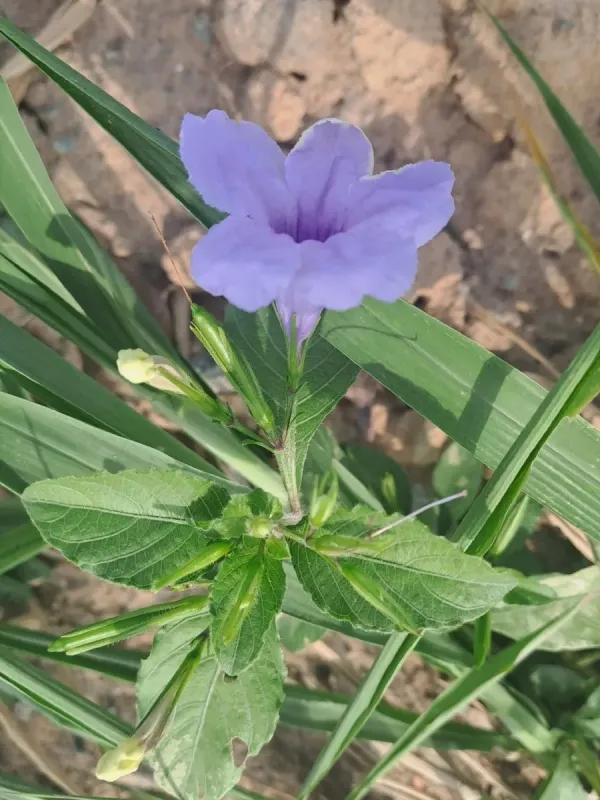
Description
How to tell it apart
Ruellia tuberosa, commonly known as the minnieroot or fever root, is a perennial herb belonging to the Acanthaceae family. The plant is easily recognized by its distinct tuberous, spindle-shaped roots, which serve as storage organs for nutrients.
The stems of the plant are usually erect, spreading, or prostrate, and they branch significantly from the base. The leaves are opposite, oblong, or elliptical, often with slightly wavy or entire margins and prominent venation patterns.
Its flowers are a notable feature, typically trumpet-shaped and varying in color from vibrant violet to lavender or blue. These flowers appear in the leaf axils and are aesthetically striking, which has sometimes led to the plant being grown as an ornamental, unfortunately facilitating its spread.
The fruit of Ruellia tuberosa is a narrow, cylindrical capsule. A unique biological mechanism allows these capsules to explode when wet, forcibly ejecting seeds over several meters, which ensures rapid colonization of nearby areas.
The regenerative capacity of its root system is exceptional. Even tiny fragments of the tuberous roots left in the soil after tilling are capable of resprouting, making the plant notoriously difficult to eradicate from agricultural lands.
Where it grows
Native to tropical regions of the Americas, Ruellia tuberosa has become an invasive species in various parts of the world, particularly in tropical and subtropical climates where it thrives in disturbed landscapes.
The weed is commonly found along roadsides, in waste areas, fields, and urban settings. It exhibits high adaptability to various soil types, including sandy, loamy, and nutrient-poor soils, showing resilience under differing environmental conditions.
In agricultural contexts, it frequently infests vegetable gardens, plantations, and crop fields. Its ability to colonize open spaces quickly makes it a primary competitor against desirable crops that require space and light.
It often establishes itself along irrigation channels and in moist lowland areas. The constant moisture in these environments supports the prolific growth of its vegetative mass and deep root storage, aiding its survival during dry seasons.
Pasturelands are also susceptible to invasion by this species. Due to its rapid spread and ability to outcompete native grasses, it can quickly become the dominant plant in poorly managed or overgrazed pastoral areas.
Harm it causes
The primary agricultural impact of Ruellia tuberosa is its fierce competition with crops for sunlight, soil moisture, and essential minerals. In dense stands, it significantly reduces the yields of vegetables and row crops.
By consuming extensive resources from the soil, the plant stunts the development of nearby crops. Its expansive root system effectively "mines" the soil, leaving fewer nutrients for the intended agricultural produce.
The plant acts as an alternative host for various pests and pathogens, potentially increasing the frequency and severity of disease outbreaks in adjacent cash crops, which raises the overall cost of crop protection programs.
High infestations create physical barriers that complicate mechanized farming practices. Tasks such as inter-row cultivation, weeding, and harvesting become labor-intensive and slower due to the presence of dense, sprawling masses of this weed.
Ultimately, the economic consequences include reduced harvests and increased expenditure on herbicides and manual labor. Without strict management, it can lead to substantial financial losses for commercial agricultural enterprises.
How to control
Cultural control methods involve frequent shallow tilling to expose and dehydrate the tuberous roots. It is crucial to manage the plant before it sets seeds, given its highly efficient explosive seed dispersal mechanism.
Repeated cutting of the above-ground biomass can help exhaust the energy stored in the tuberous roots. Over time, this constant starvation approach reduces the plant's ability to regenerate and eventually leads to its decline.
Chemical control using systemic herbicides, particularly those based on glyphosate, is often necessary for larger infestations. These should be applied while the plant is in an active growth phase to ensure translocation to the roots.
On smaller plots, manual uprooting is effective, but it must be thorough. Every fragment of the tuberous root must be removed from the soil, as any remaining piece is capable of generating a new, vigorous plant.
Preventative measures include the use of thick organic mulch or landscape fabric to shade out germinating seedlings. Furthermore, practicing robust crop rotation and maintaining high crop density helps limit the available niche for this light-loving invasive species.
Taxonomy
- Latin name
- Ruellia tuberosa
- Family
- Акантовые
- EPPO code
- RUETU