
Hygrophila costata
Hygrophila costata
Description
How to tell it apart
Hygrophila costata, known as a problematic weed, belongs to the Acanthaceae family and is characterized by its significant adaptability to high-moisture environments.
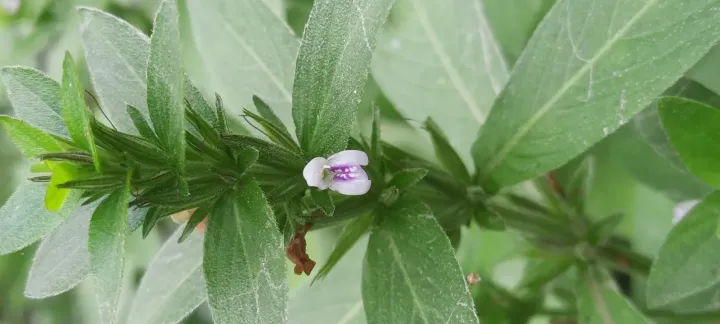
The plant features upright, four-angled stems and opposite leaves, typically lanceolate or elliptical, with prominent venation that gives it a textured appearance.
Its flowers, which grow in axillary clusters, are white with attractive purple or violet markings on the lower petals, often attracting pollinators.
The root system is robust and spreads quickly, allowing the plant to anchor firmly in mud or flooded agricultural soil substrates.
It exhibits high phenotypic plasticity, meaning it can survive both in submersed aquatic conditions and in semi-terrestrial, waterlogged habitats.
Where it grows
Hygrophila costata is native to tropical America but has become an invasive species in many tropical and subtropical regions worldwide, especially in rice-growing zones.
It thrives in rice paddies, irrigation channels, and drainage ditches where constant or frequent water stagnation creates an ideal environment for its proliferation.
The weed is frequently found along riverbanks and wetlands, taking advantage of rich soils and high water availability to form dense colonies.
It is capable of rapidly colonizing newly irrigated areas, making it a persistent nuisance in modern agricultural infrastructure.
The spread is facilitated by its ability to propagate both through seed production and vegetative fragmentation, which are easily transported by water currents.
Harm it causes
The primary concern regarding this weed is its ability to clog irrigation and drainage systems, leading to water flow obstruction and flooding risks.
In rice cultivation, it competes fiercely with crop plants for space, nutrients, and sunlight, often causing significant stunting in young rice seedlings.
Heavy infestations reduce the overall efficiency of fertilizer application, as the weed absorbs nutrients that would otherwise benefit the crop.
Increased maintenance costs are inevitable, as irrigation networks require frequent manual or mechanical cleaning to remove the aggressive biomass of this species.
The presence of Hygrophila costata also creates micro-habitats that may host pests and diseases, increasing the pathogen pressure on the main crop.
How to control
Effective control requires a multi-faceted strategy, starting with strict land preparation and the use of deep tillage to disrupt root systems after harvest.
Managing water levels is crucial; alternating between flooded and dry conditions in the field can significantly stress the weed and limit its growth cycle.
Chemical control involves the application of selective systemic herbicides, applied at the correct growth stages to ensure maximum translocation to the roots.
Crop rotation programs that include non-flooded crops can effectively starve the weed population by removing the aquatic environment it requires for survival.
Integrated weed management must also focus on preventing the spread of fragments from contaminated irrigation water through the use of filters and regular monitoring.
Taxonomy
- Latin name
- Hygrophila costata
- Family
- Акантовые
- EPPO code
- HYGCO