
Soaptree yucca
Yucca elata
Description
How to tell it apart
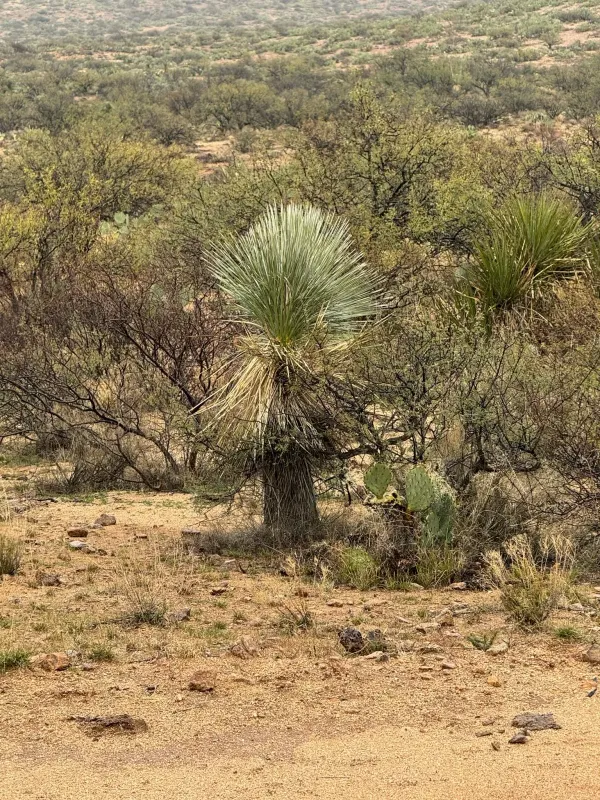
Soaptree yucca (Yucca elata) is a member of the Asparagaceae family. It is a long-lived perennial evergreen plant that develops into a tree-like shrub with a massive root system.
The plant is characterized by long, narrow, sword-shaped leaves that form a dense basal rosette. The leaf margins are typically adorned with curly white fibers, a key diagnostic feature.
During the flowering season, the plant produces a tall, impressive stalk reaching up to 3 meters in height. It bears large, cream-white, bell-shaped flowers arranged in a panicle inflorescence.
Biologically, it is highly adapted to arid environments, possessing high heat and drought tolerance. It propagates through seeds and through the expansion of its deep underground rhizomes.
The leaves are extremely tough and fibrous, making them resistant to mechanical cutting, which is a major challenge in traditional weed management programs.
Where it grows
Soaptree yucca is primarily distributed throughout the deserts of the Southwestern United States and Northern Mexico. It thrives in open, sandy, or rocky soil conditions.
It often occupies disturbed rangelands and abandoned agricultural land where the natural vegetative cover has been compromised by overgrazing or land clearing.
In its native range, it can form large, dense colonies that effectively prevent the establishment of other plant species due to its efficient resource uptake.
The plant prefers areas with excellent drainage and full sun exposure, making it a persistent fixture in desert ecosystems that are converted into grazing pastures.
It is rarely a problem in cultivated row crops, but its presence on rangelands can significantly reduce the carrying capacity of the land for livestock.
Harm it causes
The primary damage caused by soaptree yucca is its intense competition for limited water resources. Its deep root system can access soil moisture that is unavailable to shallower-rooted grasses.
The presence of dense yucca stands prevents livestock from grazing in those areas, effectively reducing the usable acreage of a pasture and increasing management costs.
The sharp points of the leaves pose a physical risk to grazing animals, potentially causing injuries and leading to secondary health issues in cattle or sheep.
Mechanical removal is extremely difficult because any remaining portion of the rootstock can regenerate, leading to rapid re-establishment of the plant on cleared sites.
By replacing nutritious forage species with non-palatable yucca, the plant significantly degrades the overall productivity and economic value of range ecosystems.
How to control
Effective control requires either complete mechanical removal of the entire root system or the application of specialized chemical treatments to reach the underground rhizomes.
Systemic herbicides, such as those containing triclopyr or glyphosate, are most effective when applied during the period of peak growth to ensure root penetration.
For chemical control, individual plant treatment (IPT) is often more effective than broadcast spraying, as it targets specific plants and reduces the impact on desirable vegetation.
Long-term management involves monitoring areas for seedling emergence and removing them before they develop extensive root systems, preventing the formation of new thickets.
- Deep mechanical extraction of rootstock.
- Individual plant herbicide application.
- Monitoring and prevention of seedling establishment.
- Integrated pasture management to encourage grass growth.
Taxonomy
- Latin name
- Yucca elata
- Family
- Спаржевые
- EPPO code
- UCCEL