
Youngia japonica
Youngia japonica
Description
How to tell it apart
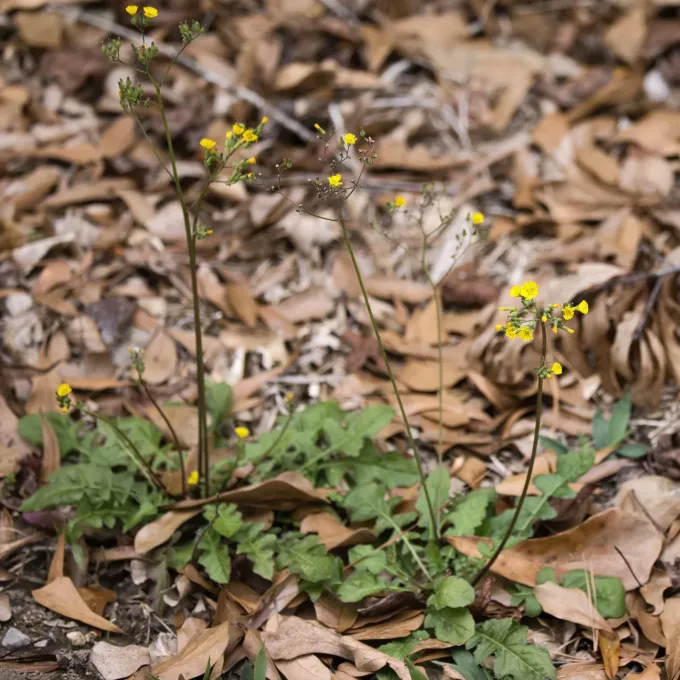
Youngia japonica, commonly known as oriental false hawksbeard, is an annual or biennial herbaceous plant belonging to the Asteraceae family.
The plant features a basal rosette of lyrate-pinnatifid leaves. The flowering stems are erect, reaching up to 50 cm in height, and often branched at the top.
The flowers are arranged in small, yellow heads forming a loose corymbiform inflorescence, which closely resembles a miniature dandelion head.
Fruits are small brown achenes equipped with a white pappus, allowing for efficient long-distance dispersal via wind and agricultural machinery.
Its root system is characterized by a sturdy taproot, enabling the weed to secure itself firmly in various soil types, ranging from sandy to clay loam.
Where it grows
Youngia japonica thrives in moist and nutrient-rich environments, commonly appearing in gardens, orchards, roadsides, and disturbed agricultural land.
This weed is highly adaptable, often found in regions with temperate to subtropical climates where it can complete its life cycle within a short period.
It poses a significant threat in row crops, nurseries, and greenhouses where conditions are optimized for plant growth, providing a perfect niche for the weed.
The plant frequently colonizes areas with frequent irrigation, taking advantage of the constant water supply to outcompete younger crop seedlings.
Its ability to establish in compacted soils makes it a common invader of paths and field edges, from where it slowly spreads into the inner cropping zones.
Harm it causes
The primary impact of Youngia japonica is its competitive nature, as it rapidly depletes soil moisture and nitrogen, severely hindering crop development.
By shading the ground, it prevents sunlight from reaching the seedlings of vegetables and other low-growing crops, leading to stunted growth and lower yields.
The weed serves as an alternative host for several pests and pathogens, increasing the risk of secondary infections spreading to nearby cash crops.
Infestations increase operational costs significantly, as farmers must invest in additional mechanical or chemical weed management to clear the field.
The high seed production per plant ensures that even a small population can result in a massive seed bank in the soil, perpetuating the problem for seasons.
How to control
Effective management begins with mechanical controls, such as manual weeding or cultivation, which should be performed before the plant initiates flowering.
Crop rotation practices that utilize cover crops can help suppress the germination of Youngia japonica by limiting light access to the soil surface.
Chemical control using systemic or selective herbicides is often necessary for large-scale infestations to ensure the safety of the main crop while eradicating the weed.
Preventative measures, including cleaning equipment between fields, are essential to stop the spread of seeds into uninfested areas of the farm.
- Timely shallow cultivation of inter-row spaces.
- Application of post-emergence herbicides.
- Implementation of mulching to suppress seedling growth.
- Rigorous monitoring of field borders to prevent seed dispersal.
Taxonomy
- Latin name
- Youngia japonica
- Family
- Сложноцветные (астровые)
- EPPO code
- UOUJA