
New York ironweed
Vernonia noveboracensis
Description
How to tell it apart
New York ironweed (Vernonia noveboracensis) is a perennial herbaceous plant belonging to the Asteraceae family, often reaching heights of 1.5 to 2 meters.
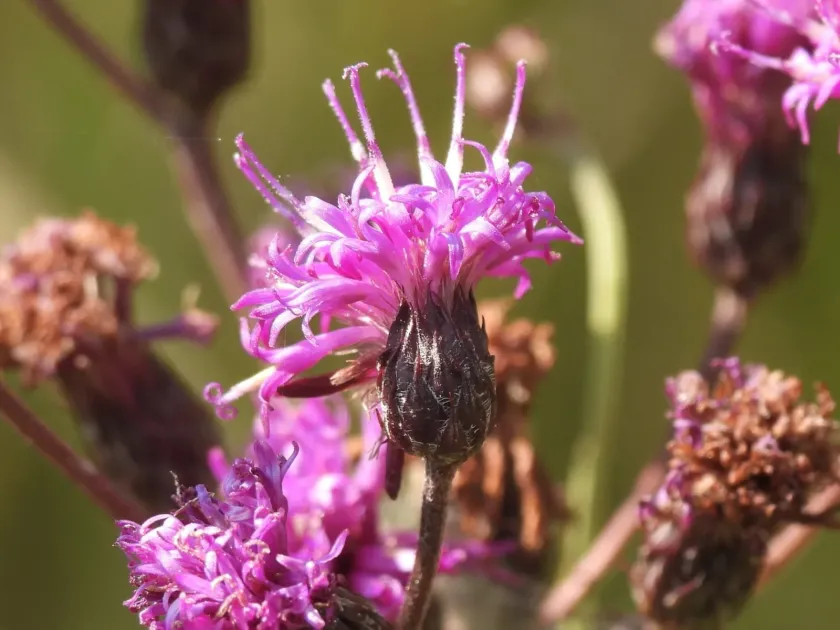
The plant is easily identified by its deep purple or violet flower heads, which are arranged in terminal, loose, corymb-like clusters at the top of stems.
Its leaves are alternate, lanceolate in shape, and possess finely serrated margins with a slightly hairy texture on the underside.
The stems are stout, upright, and often exhibit a reddish or purple tinge, contributing to the plant's robust and aggressive growth habit.
It possesses a strong, deep root system that anchors it firmly in the soil and allows it to persist even under rigorous mechanical control efforts.
Where it grows
In its native environment, New York ironweed thrives in wet meadows, riverbanks, marshes, and low-lying areas with consistent moisture availability.
As an agricultural weed, it frequently invades poorly drained fields, irrigation ditches, and areas where soil compaction leads to surface water retention.
It is commonly found colonizing pastures and hay fields, where its bitter taste allows it to dominate by avoiding consumption by grazing livestock.
The plant prefers fertile, moist soils but can adapt to a variety of disturbed environments, making it a persistent nuisance in agroecosystems.
Its prolific seed production, combined with wind dispersal, enables it to spread rapidly across damp landscape features within agricultural properties.
Harm it causes
The weed acts as a significant competitor for resources, depriving crops of essential water, minerals, and light, which often results in reduced crop yields.
In pastures, it is particularly harmful because its unpalatable taste reduces the usable forage area, leading to less efficient livestock production.
High densities of ironweed complicate harvesting operations and increase the cost of land management due to the need for repeated cutting or spraying.
Infestations can degrade the quality of hay and forage, making harvested feed less valuable and potentially introducing weed seeds to new areas.
By crowding out beneficial native flora or desired cover crops, it reduces the overall biodiversity and health of the agricultural land.
How to control
Effective management begins with improving soil drainage, as reducing excessive moisture makes the habitat less suitable for ironweed survival.
Frequent mowing before the plant reaches the flowering stage is a critical cultural control practice to deplete root reserves and stop seed production.
Deep tillage or mechanical plowing can help disrupt the root network, although this is only effective when performed consistently over several seasons.
Chemical control involving systemic herbicides is often necessary for large infestations, specifically targeting the roots to ensure complete plant mortality.
- Application of glyphosate-based herbicides on non-cropped areas or fallow fields.
- Use of selective post-emergent herbicides, such as 2,4-D or dicamba, in appropriate crop rotations.
- Strategic spot-spraying to manage localized patches before they expand into the main field area.
Taxonomy
- Latin name
- Vernonia noveboracensis
- Family
- Сложноцветные (астровые)
- EPPO code
- VENNO