
Vernonia lettermannii
Vernonia lettermannii
Description
How to tell it apart
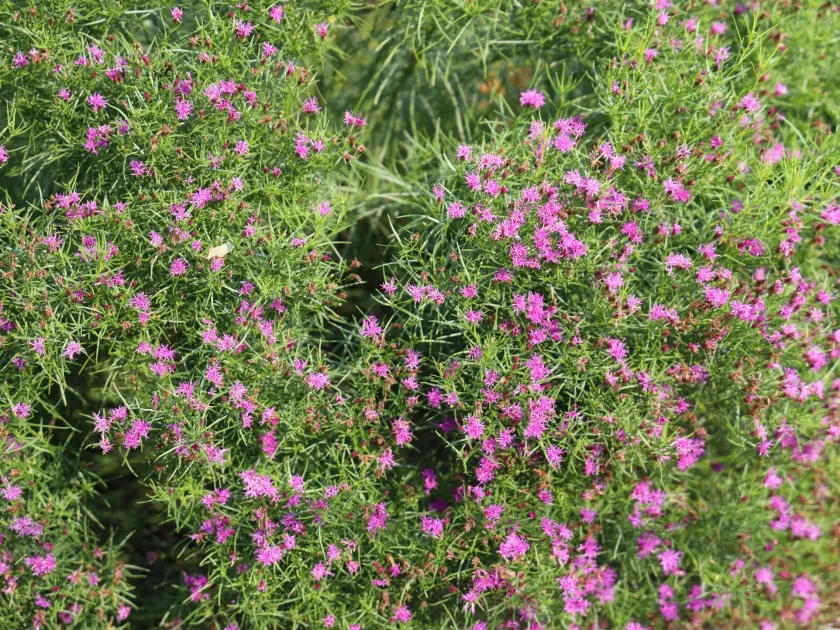
Vernonia lettermannii, commonly known as Narrowleaf Ironweed, is a perennial herbaceous plant belonging to the Asteraceae family, noted for its fine, thread-like foliage.
The stems grow in an upright habit and are typically covered in soft hairs, reaching an average height of about 40 to 60 centimeters when fully mature.
During late summer, the plant produces clusters of intense purple, disc-shaped flowers that are highly attractive to pollinators, aiding in seed dispersal.
It possesses a vigorous and deep root system that allows it to survive in harsh conditions and makes mechanical removal of the plant quite difficult.
The seeds are equipped with pappus, or bristles, which allow them to travel over long distances via wind currents, facilitating rapid colonization of new areas.
Where it grows
Native to rocky prairies and sandy soils, the plant has adapted well to disturbed sites, often spreading into agricultural fields from adjacent roadsides.
It thrives in well-drained soils and is particularly problematic in pastures and hay fields where it can outcompete desirable forage species for nutrients.
While preferring open, sunny environments, it is capable of persisting in marginal areas of crop fields where soil compaction or erosion has occurred.
It often exploits thin patches of vegetation where the canopy is not dense enough to shade out its sun-loving seedlings during the critical germination phase.
The plant demonstrates high tolerance to both moisture fluctuations and dry spells, allowing it to dominate areas where other plants might struggle to survive.
Harm it causes
As a competitive weed, it reduces the overall crop yield by depleting soil moisture and essential nitrogen, phosphorus, and potassium reserves.
Vernonia species are known to exhibit allelopathic properties, releasing chemicals into the soil that can inhibit the germination and growth of nearby crops.
Its presence in agricultural hay is undesirable because it is fibrous and generally unpalatable to livestock, reducing the quality of the harvested biomass.
The tough, woody stems of the mature plant can cause mechanical issues during harvest, potentially leading to equipment clogging and increased maintenance costs.
Once established, the plant spreads through both seed dispersal and creeping root stocks, making it a persistent nuisance that requires long-term management.
How to control
Deep cultivation and plowing remain effective mechanical control methods, as they help to disrupt and break up the extensive perennial root networks.
Frequent mowing is recommended to prevent the weed from reaching its flowering stage, thereby interrupting the life cycle and reducing the annual seed bank.
Chemical control involving systemic herbicides applied during active growth periods is necessary to effectively translocation the agent into the root system.
Integrating competitive cover crops into the rotation cycle helps shade out the weed and diminishes its ability to photosynthesize and recover.
- Implementation of strategic grazing to weaken the plant.
- Spot-spraying with herbicides to target dense infestations.
- Maintaining healthy crop density to minimize colonization gaps.
Taxonomy
- Latin name
- Vernonia lettermannii
- Family
- Сложноцветные (астровые)
- EPPO code
- VENLE