
Vernonia fasciculata
Vernonia fasciculata
Description
How to tell it apart
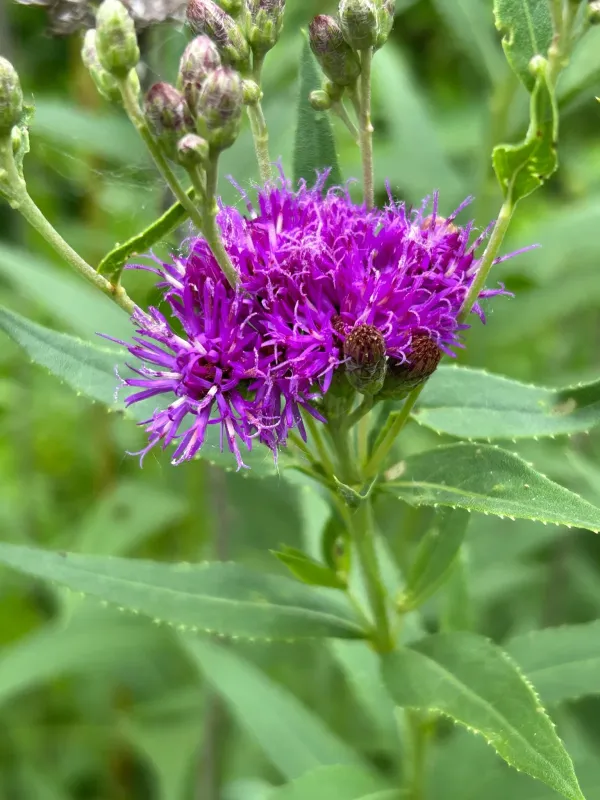
Vernonia fasciculata, commonly known as prairie ironweed, is a perennial herbaceous plant belonging to the Asteraceae family. It is recognized by its robust, upright growth habit and can reach heights of up to 1.5 meters.
The stems are often reddish, stiff, and smooth, supporting alternate, lance-shaped leaves with serrated margins. This structural integrity allows the plant to stand out among thinner-stemmed grasses.
The inflorescences are dense clusters of dark purple to pinkish flower heads arranged in flat-topped cymes. These blooms typically appear from mid to late summer, serving as a distinct identification marker.
Seeds are equipped with a pappus, a tuft of bristles that facilitates dispersal via wind currents. This ensures that the plant can colonize distant sites effectively.
The root system is tough and fibrous, often forming large crowns that allow the plant to survive harsh winters and regenerate aggressively each spring.
Where it grows
Vernonia fasciculata is native to damp prairies, meadows, and river floodplains. It thrives in deep, fertile soils that maintain moisture throughout the growing season.
In agricultural settings, it is a significant pest on permanent pastures and hay meadows where it competes with forage grasses. It is less common in cultivated fields unless tillage is infrequent.
The weed often exploits areas with poor drainage or naturally high water tables. Its presence is a strong indicator of moist soil conditions that have been left undisturbed for an extended period.
It readily colonizes neglected lands, roadsides, and edges of farm fields, where it can act as a seed source for neighboring productive agricultural acreage.
Its ability to tolerate periodic saturation makes it particularly well-adapted to bottomland environments where other less hardy species might succumb to root rot.
Harm it causes
The primary economic impact of ironweed is the reduction of forage quality in pastures. Because cattle and other livestock find it unpalatable, they will graze around it, leaving the weed to dominate the field.
As an aggressive competitor, it effectively "steals" water and nutrients from more desirable forage species. This leads to a decline in overall hay yield and nutritional content over time.
The plant’s thick, woody stems can interfere with haying machinery, causing operational delays and potential mechanical damage during the harvesting process.
Ironweed dominance can lead to the loss of biodiversity in natural grassland settings, as it suppresses the growth of smaller, native floral species through shading and root competition.
The longevity of its seed bank ensures that once established, a population of Vernonia fasciculata can persist for years, necessitating multi-year control strategies.
How to control
Mowing is a standard control practice, especially if performed repeatedly throughout the growing season to prevent flowering and seed production, effectively starving the root system.
Mechanical tillage, such as plowing, can be effective if done deeply enough to damage the root crowns. This is most successful when the soil is dry and the plants are in early stages of growth.
Chemical control involving systemic herbicides is often necessary for large infestations. Products containing 2,4-D or dicamba are typically used to target broadleaf perennials effectively.
Improving field drainage can discourage the proliferation of this weed, as it forces the soil environment to become less hospitable for ironweed development.
Maintaining a healthy, dense cover of competitive grasses is essential for long-term integrated weed management, as it minimizes the availability of space for new ironweed seedlings to establish.
Taxonomy
- Latin name
- Vernonia fasciculata
- Family
- Сложноцветные (астровые)
- EPPO code
- VENFS