
Vernonia
Vernonia
Description
How to tell it apart
Vernonia is a genus within the Asteraceae family. These plants are typically perennial herbs or shrubs, with height ranging from 30 to 150 cm, depending on the specific environment and soil nutrient availability.
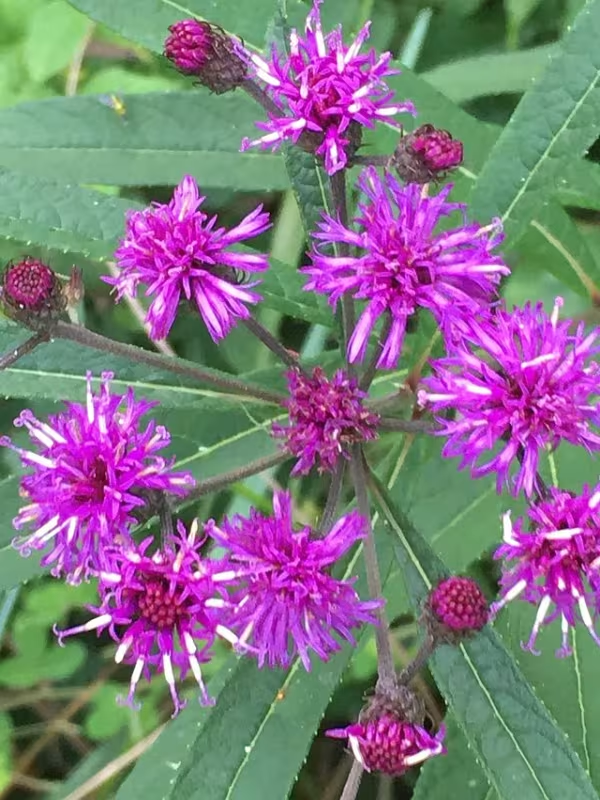
The defining feature of Vernonia is its composite flower heads, usually arranged in dense corymbs or panicles. The florets are tubular and predominantly purple, violet, or pink, making them highly visible in infested fields.
The stems are generally upright and sometimes ribbed or pubescent. Leaves are alternate, varying in shape from lanceolate to elliptical, with serrated or dentate margins which are helpful features for early identification.
Vernonia possesses a robust root system, often featuring deep-reaching rhizomes, which grant the plant excellent regenerative capabilities and allow it to overwinter in various climatic conditions.
The seeds are equipped with a pappus, a tuft of bristles that facilitates dispersal by wind, allowing the weed to spread across agricultural landscapes and colonize new areas efficiently.
Where it grows
Vernonia thrives in moist habitats, including wetlands, floodplains, riverbanks, and areas with poor drainage. It is commonly found in damp pastures and near irrigation or drainage channels.
In agricultural settings, it is a significant nuisance in row crops, cereals, and permanent grasslands. It tends to proliferate in areas where moisture levels remain consistently high throughout the growing season.
The plant exhibits high ecological plasticity, enabling it to colonize disturbed soils, roadsides, and fallow lands before infiltrating active crop fields if left unchecked.
Infestations are often observed in fields where soil management practices have been neglected, such as insufficient tillage or the failure to manage buffer zones adjacent to crop fields.
As a perennial species, it creates stable populations that can quickly dominate field margins and spread into productive areas, especially in regions with high rainfall or heavy soil types.
Harm it causes
The harm caused by Vernonia stems from its aggressive competition for water and soil nutrients. Its deep root system can deplete resources, significantly stressing nearby crop plants.
The tall growth habit and dense foliage create heavy shading, which limits the light interception of young crop seedlings, leading to reduced photosynthetic activity and stunted growth.
Vernonia acts as an alternative host for various agricultural pests and pathogens, providing them with a reservoir to survive the off-season and move into primary crops during the growing phase.
The presence of this weed at harvest leads to contamination of grain samples, which necessitates costly cleaning and processing, thereby reducing the overall quality and market value of the crop.
In grazing environments, Vernonia can be problematic as it may reduce the palatability and nutritional value of pastures, displacing more desirable forage species needed for livestock.
How to control
Controlling Vernonia requires an integrated approach that combines mechanical tillage with chemical intervention. Deep plowing is essential to disrupt and weaken the underground rhizome structures.
Effective weed management strategies involve timely cultivation and the use of targeted herbicides during the active growth phase, prior to seed formation, to prevent further spread.
Chemical control includes systemic herbicides applied during the vegetative stage to ensure the active ingredient is translocated down to the root system, preventing regrowth.
- Implement deep autumn plowing to exhaust root reserves.
- Use systemic herbicides for pre-plant or fallow field treatments.
- Maintain clean buffer zones around field perimeters.
- Practice crop rotation to disrupt the life cycle of the weed.
It is vital to monitor field edges and non-crop areas, ensuring the weed is mown or treated before it reaches the flowering stage to minimize the influx of new seeds into the cropping area.
Taxonomy
- Latin name
- Vernonia
- Family
- Сложноцветные (астровые)
- EPPO code
- VENSS