
Sea mayweed
Tripleurospermum maritimum
Description
How to tell it apart
Sea mayweed (Tripleurospermum maritimum) is a member of the Asteraceae family. It is an herbaceous plant often confused with scentless mayweed but distinguished by its preference for saline coastal habitats and specific morphological traits.
The plant grows with stems that can be prostrate or erect, typically reaching heights between 20 and 50 cm. The leaves are bipinnate or tripinnate, providing a distinct fern-like or feathery appearance.
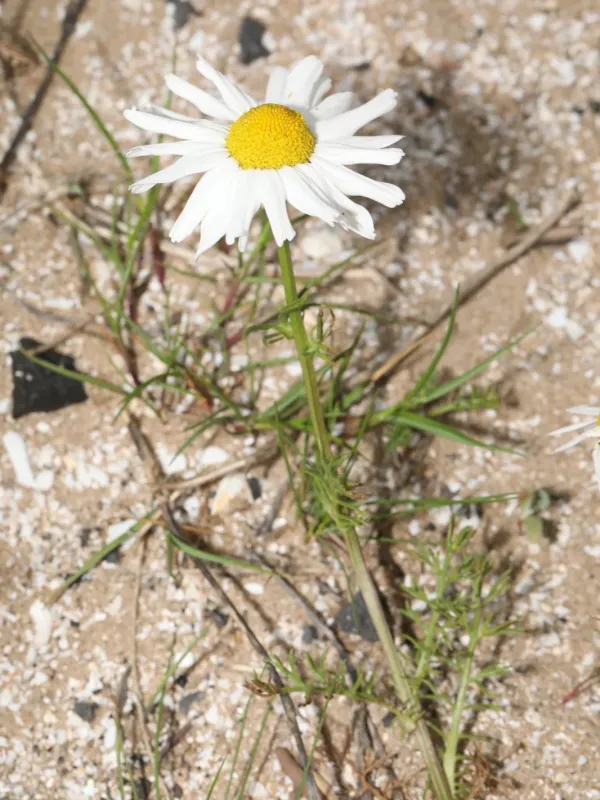
The flowers consist of yellow disc florets surrounded by white ray florets. The receptacle is conical and hollow inside, which serves as a definitive characteristic for field identification of this species.
The seeds are achenes, bearing three distinct ribs on the dorsal side. These seeds are small and lightweight, allowing for widespread dispersal via wind and agricultural machinery during harvest periods.
It is a hardy plant with a well-developed root system, enabling it to thrive in varied soil conditions, including those that are saline, sandy, or heavily compacted by agricultural activities.
Where it grows
Naturally found in coastal environments such as salt marshes and dunes, Sea mayweed has successfully migrated into inland agricultural systems where it adapts to various soil profiles.
It is commonly observed in cereal crops, row crops, and fallow fields. It thrives in open, disturbed areas where competition from established crop canopies is initially weak.
The weed frequently colonizes field edges, road verges, and waste ground. From these areas, it spreads into productive fields, often facilitated by the movement of machinery and cross-contamination of seeds.
Sea mayweed is highly responsive to moisture and nutrient availability. It tends to proliferate in areas with sufficient moisture, often establishing itself in patches rather than uniformly.
As a highly plastic species, it can survive in both dry and wet conditions, making it a persistent presence in fields where soil management practices are inconsistent or lacking.
Harm it causes
Sea mayweed competes aggressively with crops for essential resources such as nitrogen, phosphorus, and potassium, leading to significant stunted growth in the primary culture.
In cereal fields, high densities of this weed can drastically reduce yield by competing for sunlight and shading out younger plants during their most critical growth stages.
The plant acts as a host for various pests and fungal diseases, which can migrate to crops, necessitating additional chemical interventions and increasing overall production costs.
Harvesting becomes problematic when the weed is present in large numbers, as it clogs machinery and adds unwanted moisture to the grain, potentially reducing the grade of the harvest.
Livestock producers may face challenges if this weed infests pastures, as it is generally unpalatable to grazing animals and can displace more nutritious forage species.
How to control
Integrated weed management is key. This involves primary tillage techniques such as deep plowing to bury seeds, which prevents them from germinating during the optimal window for the crop.
Effective crop rotation is a vital tool, ensuring that the soil is managed through different stages, which disrupts the life cycle of Sea mayweed and prevents it from forming a permanent seed bank.
Chemical control via selective herbicides is effective, especially when applied at the early rosette stage of the weed's development before it begins to bolt and produce flowers.
Field sanitation remains a priority. Clearing field margins and ditch banks reduces the primary inoculum source of seeds, preventing re-infestation of the cultivated plots year after year.
- Early application of post-emergence herbicides.
- Mechanical weeding and inter-row cultivation for row crops.
- Establishing competitive crop densities to suppress weed emergence.
Taxonomy
- Latin name
- Tripleurospermum maritimum
- Family
- Сложноцветные (астровые)
- EPPO code
- MATMA