
Tridax daisy
Tridax procumbens
Description
How to tell it apart
Tridax procumbens, commonly known as the Tridax daisy or coatbuttons, is a perennial herb belonging to the Asteraceae family. It typically spreads across the ground, with stems rooting at the nodes.
The leaves are opposite, ovate-lanceolate, with serrated or irregularly toothed edges, and are covered in short, stiff hairs that make them feel rough to the touch.
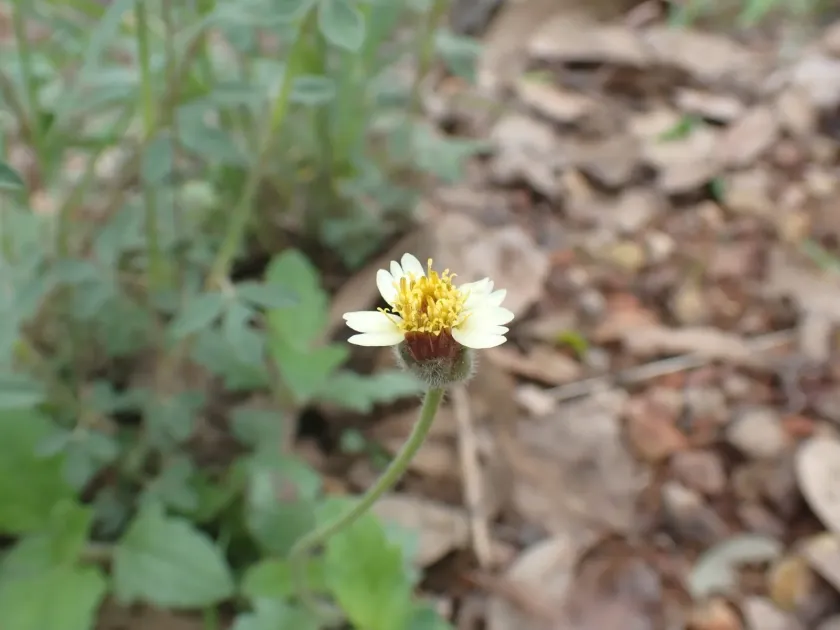
The inflorescences consist of solitary flower heads on long stalks. Ray florets are usually white or pale yellow, while the central disk florets are a distinct, deep yellow color.
Each seed is equipped with a feathery pappus, which acts like a parachute, allowing the seeds to be dispersed efficiently by wind over large distances.
Biologically, the plant is highly resilient, capable of thriving in varied soil types and under fluctuating environmental conditions, ensuring its persistence.
Where it grows
This weed is a widespread invasive species found primarily in tropical and subtropical regions. It thrives in neglected fields, roadsides, pastures, and waste grounds.
In agricultural settings, it is a significant pest in crops such as maize, rice, soybean, and cotton, where it can rapidly establish itself as a dominant ground cover.
Tridax daisy prefers open, sunny environments but displays a remarkable ability to survive in both disturbed soil and relatively infertile conditions.
It colonizes bare land very quickly, especially after tillage or other human-led disturbances, which provide the ideal conditions for its seedling growth.
Due to its high adaptability, it can compete effectively with local vegetation and invasive species alike, making it a persistent nuisance for farmers.
Harm it causes
The primary damage caused by Tridax procumbens is its intense competition with crops for sunlight, moisture, and essential soil nutrients.
Its sprawling growth habit creates dense mats that can smother young crop plants, severely hindering their early growth stages and reducing overall crop density.
The weed acts as an alternative host for numerous viruses and fungal pathogens, which can then spread to nearby cultivated crops, leading to significant disease outbreaks.
Severe infestations lower the total yield and quality of agricultural output, leading to increased costs for manual labor and mechanical harvesting processes.
On livestock pastures, the plant reduces the quality of forage as it provides little nutritional value to grazing animals and suppresses more palatable forage species.
How to control
Mechanical control, such as manual weeding or cultivation, is effective if performed repeatedly before the plant reaches its flowering and seed-setting stage.
Mulching is a highly recommended agricultural practice to prevent the light-dependent germination of Tridax seeds and to suppress the growth of established mats.
Chemical control usually involves the application of systemic, non-selective herbicides like glyphosate during land preparation phases to clear the soil before planting.
Selective herbicides are utilized when the weed appears within standing crops, but it is crucial to follow manufacturer guidelines to avoid phytotoxicity.
- Frequent field inspections
- Deep tillage practices
- Implementation of crop rotation
- Sanitation of agricultural equipment
Taxonomy
- Latin name
- Tridax procumbens
- Family
- Сложноцветные (астровые)
- EPPO code
- TRQPR