
Tolpis umbellata
Tolpis umbellata
Description
How to tell it apart
Tolpis umbellata belongs to the Asteraceae family. It is a herbaceous annual plant that often acts as a troublesome weed in agricultural settings, competing with crops for resources.
The plant features a stem that can grow between 10 and 40 centimeters in height. It typically produces a basal rosette of lanceolate leaves, with smaller, alternate leaves appearing along the stem.
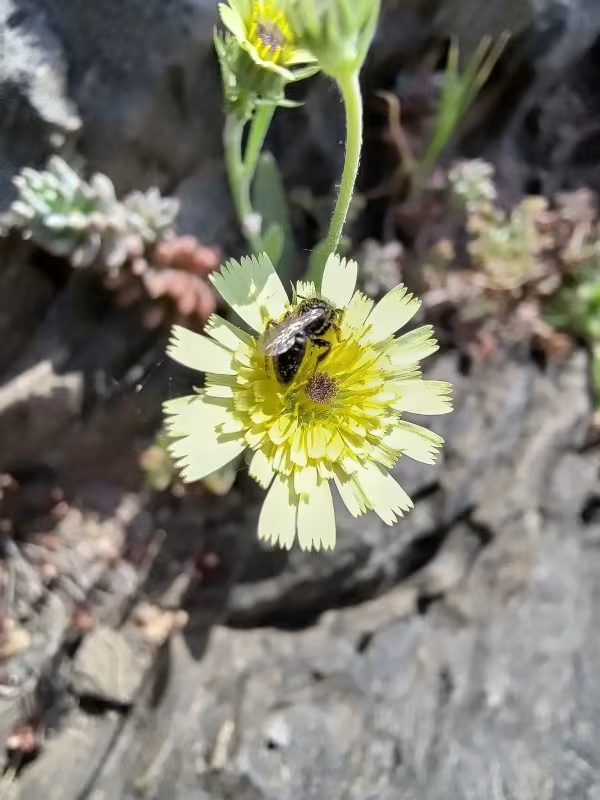
Its inflorescences are characterized by flower heads arranged in an umbel-like structure, which gives the species its common name. The flowers are typically yellow, typical for the Asteraceae family.
As an annual species, it relies on high seed production for its spread. Each plant can produce a significant number of seeds, equipped with a pappus, allowing them to travel easily by wind.
The root system is taproot-based, enabling the plant to establish itself firmly in the soil and compete for deep-seated nutrients and moisture during the spring growth phase.
Where it grows
Tolpis umbellata prefers open, sunny locations with sandy or loose soil textures. It is frequently found in arable fields, along roadsides, and in disturbed areas where it can establish dominance.
It thrives in fields with low crop density, where it can easily access sunlight. Its ability to colonize disturbed ground makes it a common invader of recently tilled or neglected agricultural land.
Seed dispersal is facilitated by wind and human activity, particularly the movement of farm machinery between fields. This mechanism allows it to infiltrate cropping systems quite rapidly.
The plant is highly adaptable to various moisture levels, which allows it to persist across different field types, from dry embankments to more fertile cropping areas.
Environmental conditions in Mediterranean climates are particularly favorable for its growth, making it a regular challenge for farmers managing cereals and vegetable rotations.
Harm it causes
The primary damage caused by Tolpis umbellata is resource competition. By consuming water, nitrogen, and other soil minerals, it directly deprives crops of the essential nutrients needed for optimal yields.
Infestations lead to reduced light penetration for the crop, causing etiolation and stress in young seedlings. This stunts growth and lowers the overall biomass production of the primary crop.
In addition to competitive loss, the presence of this weed complicates mechanical harvesting processes. Green weed matter can clog machinery, increase harvest moisture, and raise drying costs.
The weed can act as an alternative host for various pests and fungal diseases, creating a reservoir of infection that can easily spread to adjacent commercial crops during the growing season.
Economic losses arise not only from reduced yields but also from the increased cost of sorting and cleaning seeds after harvest, as the presence of weed impurities lowers commodity market grades.
How to control
Cultural control strategies include thorough soil preparation and stale seedbed techniques, which encourage weed seeds to germinate early so they can be destroyed before planting the main crop.
Crop rotation is vital to disrupting the life cycle of annual weeds. Including competitive crops that canopy quickly can significantly suppress the growth of light-dependent species like Tolpis.
Mechanical weed control, such as inter-row cultivation in row crops, is highly effective if performed before the plant reaches the bolting or flowering stages.
Chemical control should be implemented using selective herbicides labeled for the specific crop. Timing is critical, with applications most effective when the weed is in the seedling or early rosette stage.
- Pre-planting tillage and seedbed preparation.
- Implementation of robust crop rotation.
- Timely mechanical inter-row cultivation.
- Use of high-quality, weed-free seed stock.
- Application of post-emergence selective herbicides.
Taxonomy
- Latin name
- Tolpis umbellata
- Family
- Сложноцветные (астровые)
- EPPO code
- TOLBA