
Synedrella nodiflora
Synedrella nodiflora
Description
How to tell it apart
Synedrella nodiflora belongs to the Asteraceae family. It is an annual herbaceous plant that typically grows as a heavily branched bush, reaching heights of 20 to 90 centimeters.
The stems are upright, slightly ribbed, and often covered with fine hairs. The leaves are opposite, ovate or elliptical in shape, with characteristic serrated edges and prominent venation.
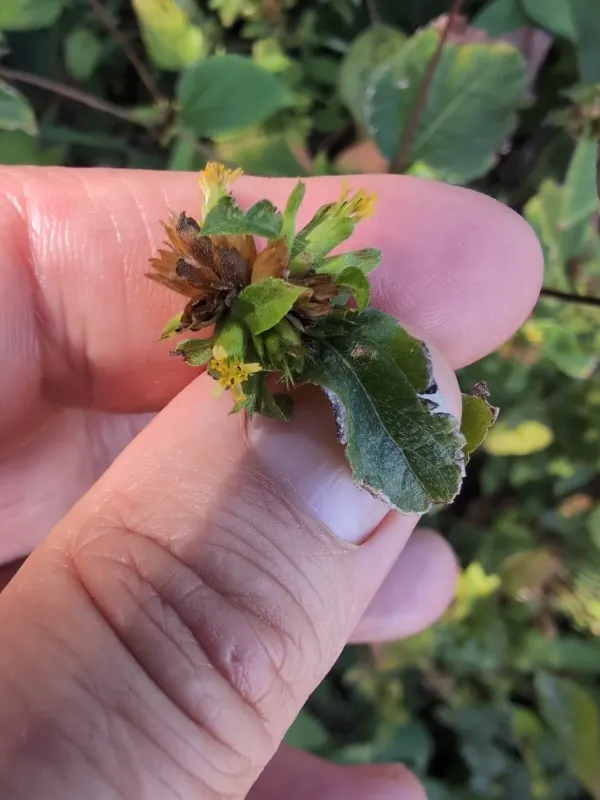
The inflorescences consist of small heads (capitula) located in leaf axils or at the tips of the branches. The flowers within the heads include both tubular and ray florets, typically yellow in color.
The plant produces two types of fruits: some are flat with winged appendages, while others are narrower with awn-like projections, ensuring efficient dispersal.
Its fibrous root system penetrates the soil deeply, allowing the plant to withstand short periods of drought and effectively compete with crops for resources.
Where it grows
This species is an aggressive weed in tropical and subtropical regions worldwide. It is found on all continents, favoring humid and warm climatic conditions.
Synedrella actively colonizes agricultural fields, including maize, soybean, cotton, and various vegetable plantations in hot climates.
The weed is frequently found along roadsides, on abandoned land, waste areas, and disturbed soils, rapidly spreading to new territories.
It prefers nutrient-rich, well-moistened soils where it can form dense thickets, effectively outcompeting less aggressive vegetation.
Under suitable climatic conditions, it is capable of producing multiple generations per year, making it a highly persistent weed in intensive farming.
Harm it causes
The primary damage caused by this plant in fields is its intense competition for limited resources, such as water, sunlight, and soil mineral nutrients.
Synedrella is capable of significantly reducing crop yields due to its high growth rate and ability to spread rapidly throughout the field.
The plant serves as an alternate host for various phytopathogens, including fungi and pests, which can subsequently spread to cultivated crops.
Infestation of fields by Synedrella complicates standard agricultural operations, such as mechanical soil cultivation and mechanical harvesting.
The species' high seed production leads to a rapid accumulation of the soil seed bank, making long-term eradication a challenging task.
How to control
Effective control requires an integrated approach that combines preventive measures, mechanical cultivation, and chemical crop protection agents.
An important element of control is timely weeding and inter-row cultivation, which allow for the destruction of young seedlings before seed set.
The application of systemic herbicides, either pre-emergence or during early growth stages, has proven highly effective in suppressing Synedrella.
Crop rotation using species that form a dense canopy helps suppress the weed naturally through shading the soil surface.
- Systematic field monitoring at early growth stages.
- Prompt eradication of weed patches before seed maturity.
- Adherence to fertilization protocols to minimize nutrient competition.
- Use of certified, weed-free seed material.
Taxonomy
- Latin name
- Synedrella nodiflora
- Family
- Сложноцветные (астровые)
- EPPO code
- SYDNO