
Hairy aster
Symphyotrichum pilosum
Description
How to tell it apart
Hairy aster (Symphyotrichum pilosum) is a perennial weed belonging to the Asteraceae family, well-known for its aggressive growth and resilience.
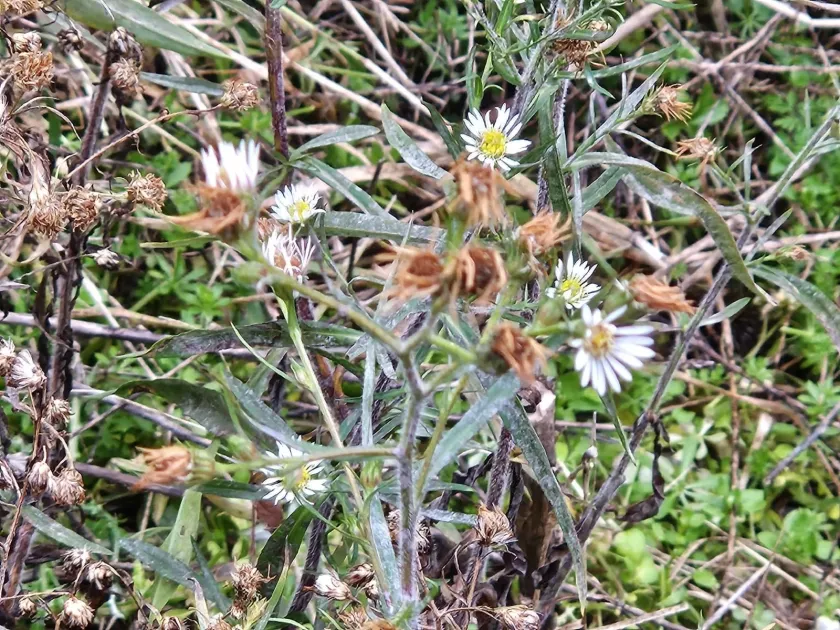
The plant features stems that are covered in fine, white, spreading hairs, which gives the species its common and scientific names.
Leaves are linear to lanceolate, with the upper leaves being smaller and entire, while the lower leaves may wither by the time the flowers bloom.
The inflorescence is a panicle of numerous small flower heads with white ray florets and yellow center disks that turn purplish with age.
It possesses a vigorous rhizome system that allows for efficient vegetative spread, making it a difficult weed to eradicate once it establishes.
Where it grows
This weed is commonly found in pastures, meadows, roadsides, and disturbed areas, often thriving in full sun or partial shade.
In agricultural settings, it invades fields with reduced tillage systems, where its root system remains undisturbed and capable of spreading.
Hairy aster is highly adaptable to various soil types, ranging from dry, rocky substrates to moist, fertile fields across agricultural regions.
It frequently colonizes field edges and fence rows, acting as a source for re-infestation of neighboring crop fields through wind-dispersed seeds.
The plant is often found in hayfields, where it can dominate the sward and degrade the nutritional quality of the forage harvested.
Harm it causes
The primary damage is caused by its aggressive competition for light, water, and nutrients, which directly reduces crop yields in heavily infested fields.
Its deep root system effectively competes with crops for moisture during drought periods, putting additional stress on the desired plants.
Hairy aster serves as a host for various pathogens and pests, including vectors for viruses that can cause significant damage to nearby broadleaf crops.
The thick stems and dense growth habit can interfere with harvesting operations, increasing the burden on equipment and resulting in higher grain moisture content.
It acts as a problematic weed in no-till farming, significantly increasing management costs through the need for repeated herbicide applications.
How to control
Mechanical control includes timely plowing and cultivation, which helps disrupt the root system and prevents the plant from storing energy for winter.
Cultural methods such as maintaining a competitive crop canopy and proper fertilization can help suppress the growth of hairy aster in the field.
Chemical control requires the use of systemic herbicides; however, the hairy surface of the leaves may reduce pesticide absorption, making adjuvants necessary.
Spot treatment of infested areas before seed set is crucial to prevent the further spread of seeds into the main production fields.
- Use systemic herbicides during the rosette stage.
- Maintain crop rotation to break the life cycle.
- Mowing before seed production in non-crop areas.
- Implement proper surfactant use with chemicals.
Taxonomy
- Latin name
- Symphyotrichum pilosum
- Family
- Сложноцветные (астровые)
- EPPO code
- ASTPI