
Purple ragwort
Senecio elegans
Description
How to tell it apart
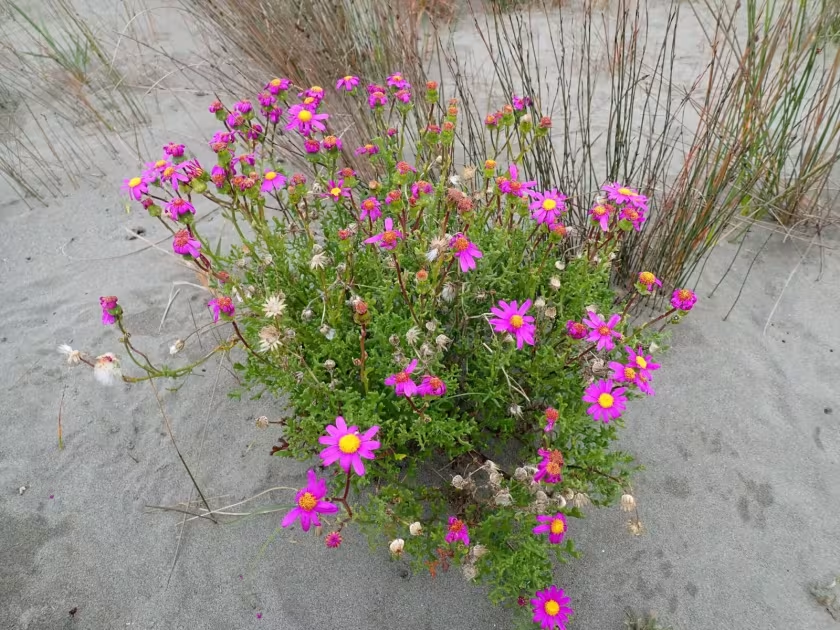
Purple ragwort (Senecio elegans) belongs to the Asteraceae family. It is an annual herbaceous plant that can reach a height of 20 to 60 centimeters.
The stem is upright, often branched, and covered with characteristic sticky glandular hairs. The leaves are deeply divided, lyre-shaped, and sessile, clasping the stem at the base.
The inflorescence is a flower head up to 3 centimeters in diameter. The ray florets are typically purple or pink, which distinguishes it from other ragwort species.
Reproduction occurs entirely through seeds, which are equipped with a pappus that allows them to be easily dispersed over significant distances by wind.
It possesses a taproot system that reaches a moderate depth, providing the plant with stability and resilience during the early stages of its growth cycle.
Where it grows
Native to South Africa, it has successfully naturalized in many regions with mild climates, preferring sandy, well-drained, and disturbed soils.
It is commonly found as a ruderal weed along roadsides, on abandoned lots, in coastal areas, and on sites with disturbed topsoil layers.
In agriculture, it poses a threat to vegetable crops, cereals, and row crops grown on sandy or well-drained soil types.
The plant aggressively colonizes empty spaces in orchards, vineyards, and decorative nurseries, forming dense stands whenever moisture is available.
As a heliophyte, it thrives in open areas where there is minimal competition from dense crop canopies, allowing it to establish quickly.
Harm it causes
The primary damage stems from intense competition with crops for essential nutrients, solar energy, and soil moisture during critical growth stages.
Infestation significantly reduces crop yields and complicates mechanical harvesting due to the rapid accumulation of plant biomass.
The plant contains alkaloids that are toxic to livestock if ingested, posing a serious safety risk in pastoral farming and grazing environments.
The seeds possess high viability, leading to rapid soil contamination and the formation of a persistent seed bank that disrupts standard crop rotation practices.
Widespread occurrence of this weed can promote the development of specific pathogens that may transfer to related agricultural species within the Asteraceae family.
How to control
Agronomic measures include deep autumn plowing to bury seeds at depths that prevent successful germination in the following season.
Timely inter-row cultivation before the flowering phase is essential to prevent the maturation and dispersal of seeds into the field.
Implementing crop rotations that include dense-growing cover crops helps suppress weed development through shading and competitive exclusion.
Chemical control is achieved through the application of systemic herbicides, which show high effectiveness when applied at the rosette or early stem elongation stages.
- Use of glyphosate-based herbicides for localized control on roadsides and non-arable borders.
- Regular mowing of the vegetative biomass before the first flower heads emerge to reduce the local seed bank.
Taxonomy
- Latin name
- Senecio elegans
- Family
- Сложноцветные (астровые)
- EPPO code
- SENEG