
Schkuhria pinnata
Schkuhria pinnata
Description
How to tell it apart
Schkuhria pinnata is an annual herbaceous plant belonging to the Asteraceae family. It typically features an upright, branched stem, reaching heights ranging from 20 to 60 centimeters depending on environmental conditions.
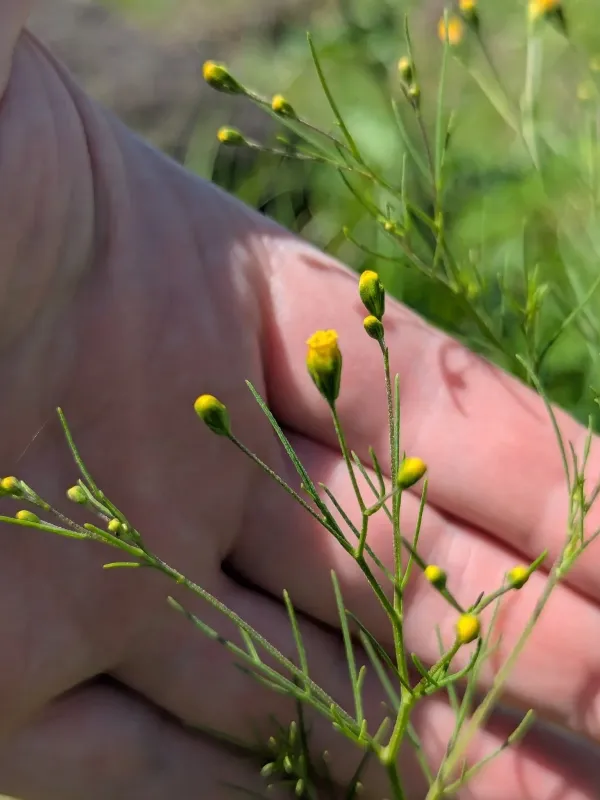
The leaves are characteristically pinnate, with deeply divided, narrow segments. This fern-like or feathery appearance is a diagnostic feature that helps differentiate it from other members of the Aster family found in agricultural areas.
The inflorescences are composed of small flower heads organized into loose, corymb-like clusters. The florets within these heads are predominantly yellow, and the involucre is composed of few, often uniseriate, bracts.
The fruit of the plant is an achene, which is topped with a pappus consisting of small scales. This structural adaptation allows the seeds to be easily dispersed over long distances by wind currents, facilitating the rapid colonization of new areas.
Upon crushing, the plant emits a distinct, pungent scent due to the presence of volatile essential oils. It possesses a taproot system, which helps the plant remain anchored and provides resilience during short-term water shortages.
Where it grows
Schkuhria pinnata is an invasive species originating from South America. Over time, it has successfully naturalized in many temperate and subtropical regions worldwide, including parts of Africa, Australia, and various countries in Eurasia.
This weed is commonly found in row-cropped fields, along roadsides, on fallow agricultural land, and in disturbed urban areas. It shows a preference for well-lit environments and loose, well-drained soil substrates.
In agricultural settings, it can be a highly competitive plant. It thrives in areas where soil has been recently disturbed or where the density of the main crop is insufficient to shade out developing weeds.
Biological plasticity allows the species to adapt to a variety of soil types, ranging from sandy to loamy soils. This adaptability makes it a significant concern for a wide array of agricultural production systems.
It reproduces exclusively through seeds, which are produced in large quantities. The seeds can remain viable in the soil for several seasons, creating a persistent seed bank that makes eradication challenging.
Harm it causes
The primary harm caused by Schkuhria pinnata is its intense competition for limited resources such as soil moisture and nutrients. It competes with crops for sunlight, often shading out developing seedlings in early growth stages.
The presence of this weed in field crops often complicates mechanical operations. It can clog harvesting machinery, and high infestation densities are known to cause significant reductions in both yield and final product quality.
As a host plant, Schkuhria pinnata may harbor various pests and pathogens that can subsequently migrate to economically important crops. This increases the overall phytosanitary risk and leads to higher expenditures for pesticide applications.
Seed contamination is a major issue during the harvest of cereal and seed crops. The presence of these seeds often necessitates expensive cleaning procedures to ensure the quality of the harvested produce meets market standards.
The plant demonstrates a capacity for rapid spread, often establishing along field edges and progressively moving into the center of the crop stands. Without proactive intervention, infestation levels can rise significantly within a few seasons.
How to control
Cultural control methods involve deep tillage, which serves to bury seeds deep enough to prevent successful germination. Regular inter-row cultivation is highly effective for eliminating young seedlings before they reach reproductive maturity.
Implementing a diverse crop rotation is a key strategy, particularly incorporating crops that provide rapid canopy closure to shade out emerging weeds. Cover crops can also be used to suppress germination by modifying the microenvironment.
Chemical control focuses on the use of selective herbicides. For optimal results, application should target the plant during its early seedling stages, before it develops significant biomass and enters the flowering phase.
Sanitation is essential; managing populations on field boundaries, roadsides, and wasteland prevents the secondary dispersal of seeds onto cropped land. Preventing the weed from setting seed is the most effective long-term management tool.
- Deep primary tillage.
- Strategic crop rotation.
- Mechanical inter-row cultivation.
- Targeted herbicide application.
- Mowing before flowering.
Taxonomy
- Latin name
- Schkuhria pinnata
- Family
- Сложноцветные (астровые)
- EPPO code
- SCKPI