
Salicornia virginica
Salicornia virginica
Description
How to tell it apart
Salicornia virginica, commonly known as Virginia glasswort or pickleweed, belongs to the Amaranthaceae family. It is a perennial, succulent, salt-tolerant plant that is perfectly adapted to environments with high saline concentrations where most common crops would fail.
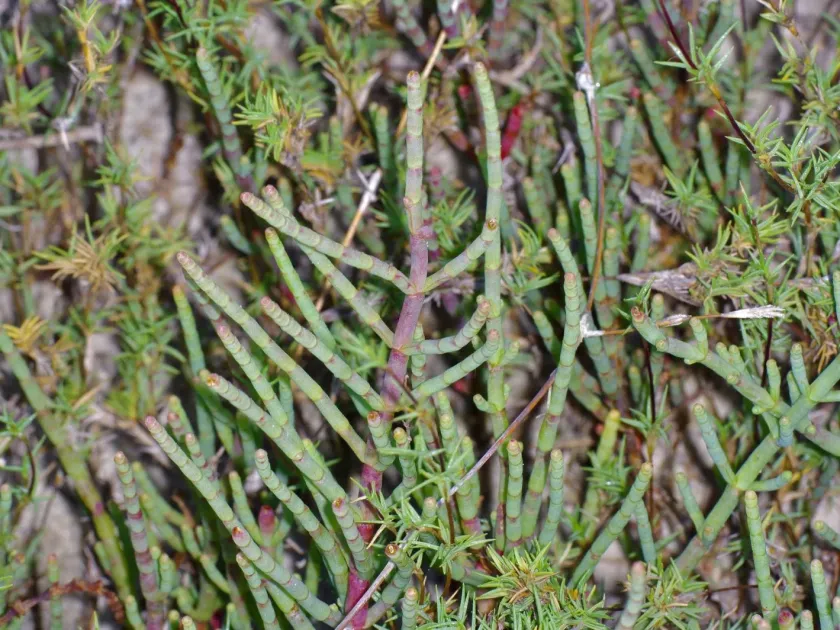
The plant is easily identifiable by its leafless, jointed, and fleshy stems. These stems can appear green or turn reddish-purple during the reproductive phase, giving the plant a distinctive look among other marsh flora.
Its root system is fibrous and highly specialized, allowing it to extract water from saline soils efficiently. This adaptation helps the plant maintain turgor pressure despite the osmotic stress caused by high salt levels in its growing medium.
The flowers are extremely small, inconspicuous, and embedded within the succulent stem segments. They are wind-pollinated, leading to the production of small seeds that are capable of spreading through water currents in salt marshes and irrigated fields.
Being a perennial, it can also regenerate from stem fragments, making it a persistent weed that forms dense mats. These patches can easily overwhelm local vegetation and disrupt the growth of desired crops in agricultural settings.
Where it grows
Salicornia virginica is typically found in salt marshes, mudflats, and inland saline areas. It thrives in intertidal zones and areas where high evaporation rates lead to salt accumulation in the upper soil horizons.
In agriculture, this plant acts as a major weed in irrigated systems suffering from secondary salinization. Poor drainage practices in arid climates often create the exact conditions, such as wet, saline soils, that the plant requires to flourish.
The weed is frequently found along irrigation channels and drainage ditches. Because the seeds are buoyant, they can be easily transported by irrigation water to various parts of a field, starting new colonies in previously clean areas.
It prefers moist, saline environments and is often a dominant species in disturbed wetlands. In areas where soil management is neglected, Salicornia virginica can quickly become the primary vegetation, altering the local ecological balance.
Its distribution is closely linked to geological and hydrological factors, including seawater intrusion and improper water management in farming operations that rely on groundwater or high-salt irrigation sources.
Harm it causes
The primary harm caused by Salicornia virginica is its intense competition with crops for water, space, and nutrients. Because it is highly efficient at handling salt, it can outcompete less salt-tolerant crops in areas where soil chemistry is suboptimal.
The plant alters the soil environment by accumulating salts in its tissues. As the plant biomass decays, it releases concentrated salts back into the topsoil, further increasing soil salinity and making the land less productive for future rotations.
It creates significant mechanical obstacles for agricultural equipment. Dense patches of pickleweed can clog irrigation infrastructure, leading to stagnant water, uneven water distribution, and ultimately, lower yields for the entire field.
For pastoral farmers, the presence of Salicornia virginica on grazing land is problematic. While some livestock might consume it in small amounts, it is generally considered poor-quality forage due to its high mineral and salt content.
The persistent nature of the plant means it occupies land for long periods, requiring costly and time-consuming efforts to clear. This leads to increased overhead costs for farm management and reduced land value in affected regions.
How to control
Controlling Salicornia virginica requires an integrated approach focusing on soil remediation. The most effective long-term solution is to improve field drainage and implement irrigation techniques that flush excess salts from the root zone.
Agronomic control practices include deep tillage to disrupt the root networks and improve the physical structure of the soil. Planting salt-tolerant cover crops can also help by shading out the weed and competing for available soil moisture.
Chemical control is challenging as the plant is adapted to extreme conditions. Non-selective herbicides can be used as a spot treatment in specific areas, but they must be applied with care to avoid damage to surrounding vegetation and soil quality.
Preventive measures are crucial to keep the weed from spreading. This includes cleaning irrigation channels regularly, using clean seed sources, and ensuring that water inflow into fields does not carry weed seeds from infested marshy areas.
- Installation of improved subsurface drainage systems.
- Regular mowing or tillage before seed set to reduce the seed bank.
- Strategic application of systemic herbicides in isolated patches.
- Monitoring soil salinity levels to manage irrigation inputs effectively.
Taxonomy
- Latin name
- Salicornia virginica
- Family
- Амарантовые
- EPPO code
- SAAVI