
Rhaponticum centauroides
Rhaponticum centauroides
Description
How to tell it apart
Rhaponticum centauroides is a perennial herbaceous plant belonging to the Asteraceae family. It is recognized by its sturdy stem and complex root system.
The leaves are characterized by a rosette at the base, with pinnately lobed structures that become smaller as they progress up the stem, often displaying a coarse, serrated edge.
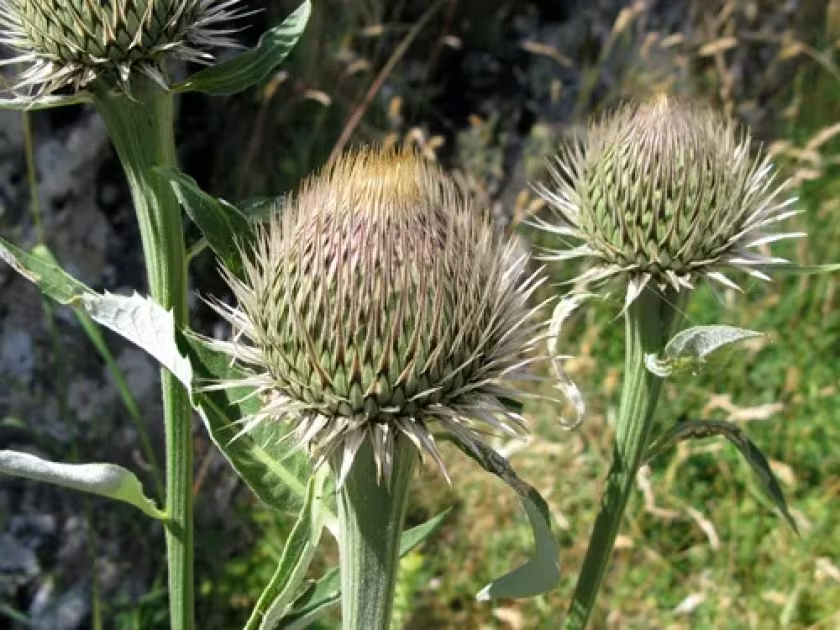
The inflorescences are distinct large flower heads resembling thistles or cornflowers, typically exhibiting purple or pinkish floral bracts.
This plant propagates both via seeds and through a persistent root system, making it a formidable perennial competitor in various ecological conditions.
The bracts of the flower heads are a key identification feature, often having membranous appendages that help distinguish this species from other related Asteraceae.
Where it grows
Rhaponticum centauroides primarily thrives in steppe and forest-steppe regions, preferring well-lit environments and fertile, moisture-retentive soils.
It frequently invades cereal crops, forage lands, and cultivated fields, where it can quickly establish dense patches that disrupt the uniform growth of the crop.
The weed is commonly found in uncultivated areas, such as field margins, road verges, and idle plots, which serve as reservoirs for future infestations.
Its high environmental plasticity allows it to adapt to diverse soil types, including heavy clays and rocky terrains, where other plants might struggle to establish.
The dispersal of the weed is often facilitated by farm machinery during soil cultivation, which fragments the root system and spreads it across fields.
Harm it causes
The primary damage caused by this weed is the intense competition for soil resources, as its deep root system depletes nitrogen and water needed by crops.
By forming dense colonies, it provides shade to crop seedlings, significantly reducing photosynthetic efficiency and overall biomass production during the growth phase.
Rhaponticum centauroides complicates harvesting operations, often leading to increased grain moisture and higher levels of dockage in harvested loads.
Furthermore, it acts as a host for various agricultural pests and pathogens, which can easily migrate to neighboring healthy crop stands during the growing season.
The presence of this weed reduces the overall aesthetic and economic value of the field, requiring additional expenditures on herbicides and labor-intensive mechanical treatments.
How to control
Effective management of this weed requires an integrated approach that combines deep tillage with the precise application of systemic herbicides.
Mechanical control should focus on deep plowing, which helps in exposing the root system to unfavorable environmental conditions, causing desiccation.
Frequent inter-row cultivation is highly recommended in row crops to disrupt the root networks and prevent the formation of new vegetative shoots.
Chemical control involves the application of selective systemic herbicides during the rosette stage of the weed to maximize the uptake of the active substance.
- Implementation of diverse crop rotations to disrupt weed life cycles.
- Use of glyphosate-based herbicides on fallow or post-harvest fields.
- Maintaining clean field borders to prevent further seed dispersal.
- Constant monitoring of fields for early detection and rapid spot treatment.
Taxonomy
- Latin name
- Rhaponticum centauroides
- Family
- Сложноцветные (астровые)
- EPPO code
- RCMCE